Sell to Oil and Gas in 2026: 3 High-Authority Sales Strategies
By Modalpoint | An EWR Digital Company
The 2026 reality check is here, and it is cold. If you are still walking into Houston boardrooms or Midland field offices talking about “disruption” or “innovation,” you have already lost. The industry isn’t chasing production records anymore; it is chasing ROIC (Return on Invested Capital) and operational reliability. In the current market, the “generalist” salesperson is an endangered species. To sell to oil and gas operators today, you must move past the glossy brochures and speak the language of integration maturity and carbon intensity.
The “Great Compression” of the mid-2020s has filtered out the noise. Procurement teams are no longer interested in experimental tech that lacks a clear path to oilfield services sales scalability. They want to know how your solution impacts the bottom line within a single fiscal quarter. If you cannot map your value proposition to a specific vertical, whether it is Upstream, Midstream, Downstream, or Service, you are just adding to the digital slop that fills their inboxes.
Strategic Oil & Gas Market Entry 2026: Beyond the Digital Twin
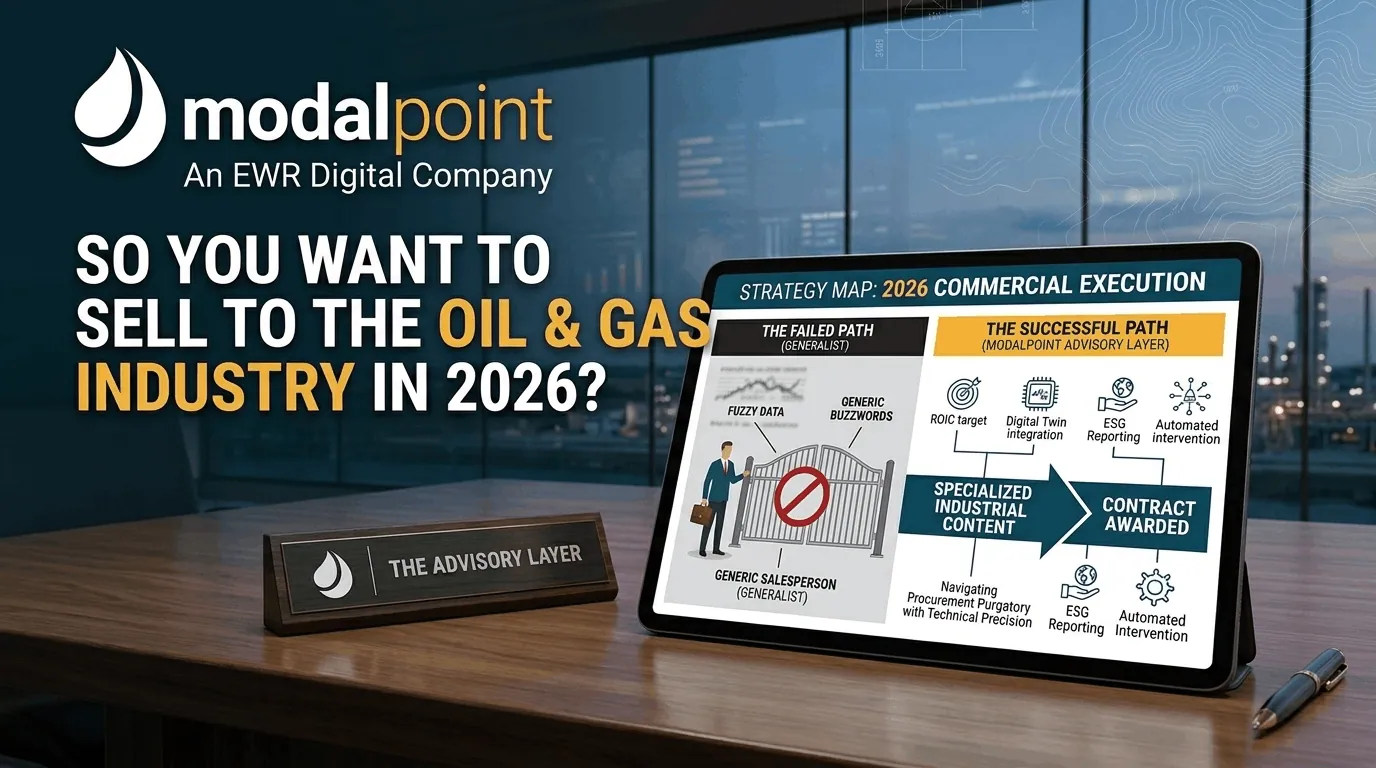
To succeed in the oil & gas market entry in 2026, you have to understand that the “Digital Transformation” era is dead. It has been replaced by the “Execution Era.” Companies are no longer buying “visibility”; they are buying “automated intervention.” When you approach a CTO or a VP of Operations, your pitch needs to focus on how your software or hardware integrates into existing SCADA systems without creating a new data silo.
Before you can effectively sell to oil and gas entities, you must audit your own commercialization strategy. Most firms fail because they treat the energy sector like a standard SaaS market. It isn’t. This is a relationship-heavy, high-stakes environment where a single hour of downtime can cost hundreds of thousands of dollars. You are not just selling a product; you are selling a guarantee of uptime and a reduction in capital risk. This is the core of high-authority energy marketing, which bridges the gap between technical capability and commercial reality.
Navigating Procurement Purgatory with Technical Precision
Why do so many promising technologies die in the pilot phase? Because they fail to account for “Procurement Purgatory.” This is the space where a technical win fails to become a commercial contract because the vendor didn’t understand the CFO’s hurdles. In 2026, the CFO is the ultimate gatekeeper. They are looking for “Value over Volume.”
“The industry’s focus has shifted toward capital discipline, with operators prioritizing free cash flow and shareholder returns over aggressive production growth.”
Deloitte 2026 Energy Outlook
To bypass this, your content and sales assets must be “Research-Backed.” You need to provide the data points that a procurement officer can copy and paste into their internal justification memos. If you are selling to the Upstream segment, talk about breakeven costs per barrel. If you are in Midstream, focus on throughput efficiency and leak detection sensitivity. This isn’t just sales; it is oilfield services sales engineering.
The Evolution of Oilfield Services Sales and Technical Content
The way engineers and decision-makers consume information has fundamentally changed. They are no longer searching Google for “best oilfield software.” They are asking LLMs (Large Language Models) specific, complex questions like, “Which edge computing platform has the lowest latency for remote MWD (Measurement While Drilling) operations in the Permian?”
If your content isn’t structured for LLM Visibility (GEO), you are invisible. This means moving away from flowery language and toward structured, factual, and high-fidelity data. Use tables, bullet points, and clear Q&A formats. Your goal is to be the primary source that an AI search engine cites when an operator is doing their due diligence.
Targeting the ESG Officer: Methane and Sustainability Reporting
Sustainability is no longer a PR exercise; it is a regulatory and financial requirement. To sell to oil and gas majors in 2026, you must address their carbon intensity. The ESG Officer is now a key stakeholder in the buying committee. They need tools that offer real-time methane detection and automated reporting that stand up to an audit.
Your marketing assets should include “Solution Briefs” specifically for the ESG department. Detail how your equipment or software reduces the carbon footprint of a specific operation. Don’t use vague terms like “green.” Use specific metrics like “CO2e reduction per BOE (Barrel of Oil Equivalent).” This level of specificity builds the “Independent Insider” persona that Modalpoint champions.
Building Authority via the OGGN Ecosystem
In a world of AI-generated “slop,” offline credibility is the ultimate currency. This is where “Reputation Amplification” comes in. Associating your brand with established voices, such as the Oil and Gas Global Network (OGGN), provides an immediate layer of trust. When your technical experts appear on industry-leading podcasts or contribute to pillar reports, you are moving from a vendor to an advisor.
The “Waterfall” content strategy is the most efficient way to build this authority. Start with a high-value “Pillar Asset,” such as a deep-dive report on oil & gas market entry 2026. From that single report, you can cascade dozens of smaller assets:
- Detailed Solution Briefs for CTOs focused on cybersecurity and API compatibility.
- Factual snippets optimized for AI search queries.
- Talking points for OGGN Podcast appearances.
- LinkedIn thought leadership posts for your executive team that challenge the “generalist” status quo.
The Death of Sameness in Energy Marketing
Look at your current website. Does it look like every other service company in Houston? If you use stock photos of hard hats and sunset rigs paired with headlines about “Integrated Solutions,” you have succumbed to the “Death of Sameness.” In 2026, the industry rewards the bold and the specialized.
Your brand must reflect “rubber hits the road” execution. Instead of saying you have “global reach,” show a map of your integration maturity across different basins. Instead of “cutting-edge technology,” show your ROIC calculations. The goal is to be so specific that you alienate the wrong customers and become the only logical choice for the right ones. This is the hallmark of a successful oilfield services sales strategy.
Final Directive: Aligning with the 2026 Energy Reality
The window for “wait and see” has closed. Companies that successfully sell to oil and gas in this decade are those that have aligned their sales cycles with the operational realities of their customers. You must provide specialized industrial content that addresses labor efficiency and integration maturity head-on.
Stop contributing to the noise. Start providing the “Advisory Layer” that your clients actually need. Whether you are navigating the oil & gas market entry in 2026 for a new startup or trying to revitalize a legacy brand, the path forward is the same: High-Context, Research-Backed, and Vertically Aligned. For more insights on building a commercialization strategy that actually works in the field, visit Modalpoint.
How operators buy has moved on since this post. The handshake-and-golf era gave way to procurement gates, ROIC scrutiny, and buyers who form opinions in AI answers before they ever take a call. Selling into oil & gas today means engineering for how the industry actually decides.