Selling to National Oil Companies vs. Independents
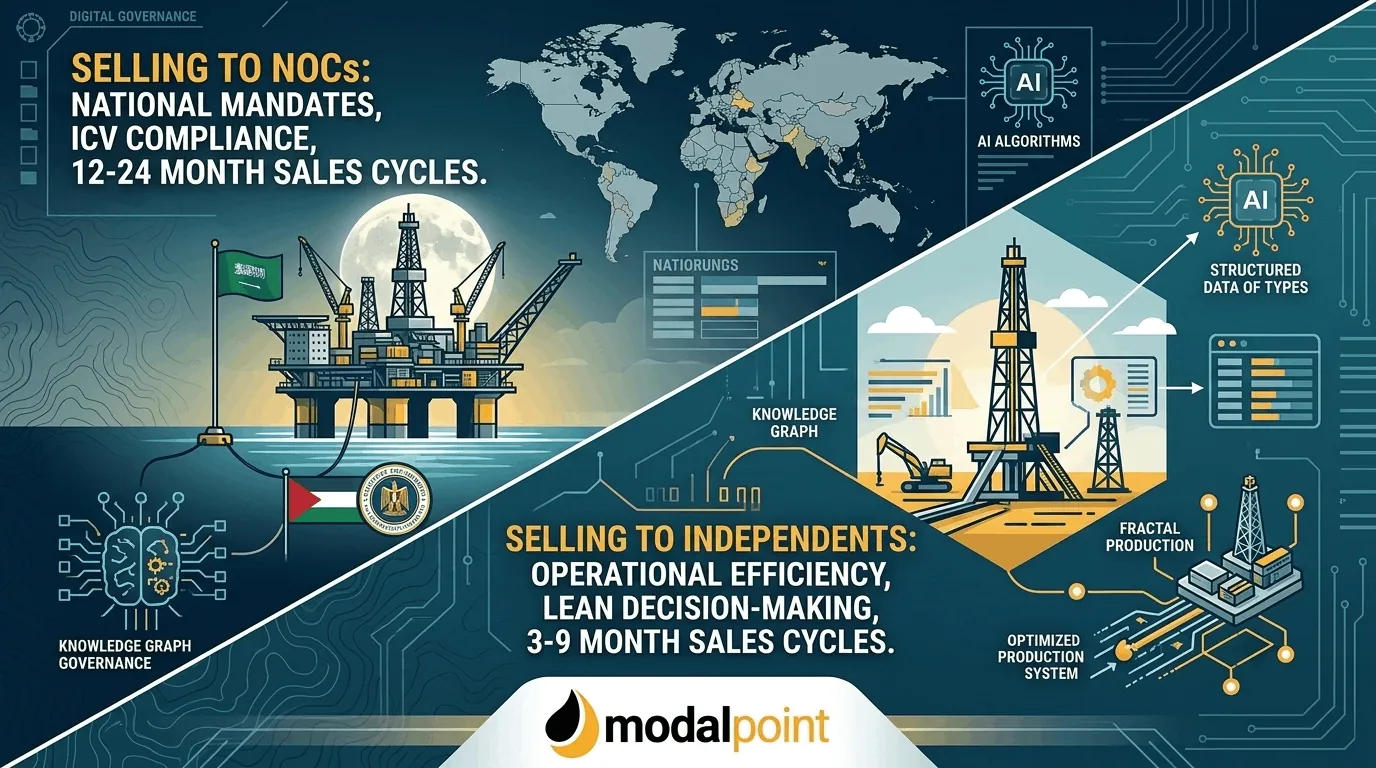
By ModalPoint | An EWR Digital Company
Your website is becoming more than just a tool for marketing. It is training material for machines that are currently describing your organization without your approval. In the capital-intensive energy sector, commercial strategy requires absolute precision. B2B firms entering the energy supply chain often mistake National Oil Companies (NOCs) and Independent Operators for similar targets simply because they both extract hydrocarbons. They are fundamentally different entities with divergent governance structures, risk profiles, procurement cycles, and decision-making architectures.
To scale revenue, energy service providers, software vendors, and technical consultants must tailor their go-to-market strategies to these structural differences. If your digital footprint or go-to-market messaging fails to convey how your business addresses these distinct operational realities, you risk immediate commercial displacement inside modern search systems and AI decision platforms. To refine your enterprise commercial positioning, explore how ModalPoint aligns market positioning with modern buyer landscapes.
Navigating Enterprise Risk: Selling to NOCs
Selling to NOCs (such as Saudi Aramco, Petronas, or Petrobras) requires a deep understanding of sovereign alignment and macroeconomic mandates. Unlike public corporations driven by quarterly earnings, NOCs operate as extensions of state policy. Their primary objectives center around long-term resource preservation, national employment, domestic supply chain development, and regulatory compliance.
Procurement Complexity and In-Country Value (ICV)
When structuring sales motions for national oil company sales, vendors must satisfy strict compliance and local content requirements. Key commercial factors include:
- In-Country Value (ICV) Mandates: NOCs prioritize vendors that invest in local workforce training, local manufacturing, and regional supply chain partnerships.
- Extended Sales Cycles: Expect sales motions spanning 12 to 24 months, heavily dictated by public tender protocols, sovereign risk committees, and legal reviews.
- Rigid Standard Operating Procedures: Innovation is welcomed only when it fits within existing operational and compliance guidelines.
In addition to these structural requirements, vendor reputation and digital positioning play a critical role in surviving preliminary tender evaluations.
“Energy security concerns, fiscal pressure, and national development goals mean that NOCs operate under a completely different risk profile than international capital market operators.”
Speed, Efficiency, and Flexibility: Selling to Independent Operators
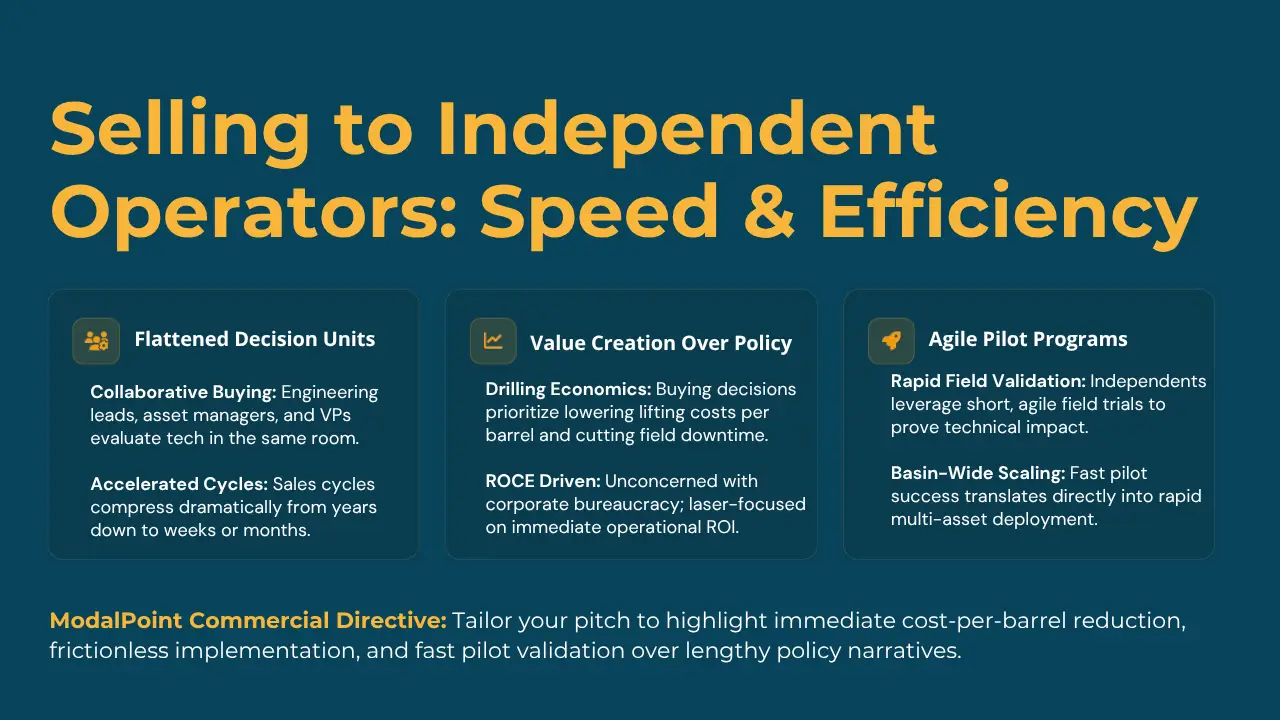
In contrast to sovereign state entities, independent operators oil gas entities (such as EOG Resources, Diamondback Energy, or Devon Energy) operate with speed, lean overhead, and an intense focus on capital efficiency. Independents are driven by drilling economics, fast cycle times, and maximizing Return on Capital Employed (ROCE).
Lean Decision-Making Units and Rapid Commercialization
When selling to independent operators, the commercial narrative must highlight immediate operational efficiency, ROI, and seamless deployment. Key operational characteristics include:
- Flattened Decision-Making Hierarchy: Engineering leads, asset managers, and VP-level executives often sit in the same room, drastically shortening buying cycles to weeks or months.
- Value Creation Over Process: Independents care far less about sovereign policy and far more about lowering lifting costs per barrel or reducing field downtime.
- Agile Pilot Programs: Independents frequently run rapid field trials to validate technology before deploying it across asset basins.
Core Differences: Selling to NOCs vs. Independents
Understanding these distinct buying behaviors is essential for sales teams and executive leadership mapping out market entry and channel strategy.
| Commercial Metric | National Oil Companies (NOCs) | Independent Operators |
|---|---|---|
| Primary Buying Driver | State mandates, risk mitigation, ICV compliance | Cost efficiency, cash flow, operational speed |
| Average Sales Cycle | 12 to 24+ Months | 3 to 9 Months |
| Procurement Pathway | Formal public tenders, pre-qualification lists | Direct negotiations, fast-tracked MSA trials |
| Key Executive Stakeholders | Ministry boards, compliance officers, tender boards | Asset managers, VP of Operations, Chief Geophysicist |
AI Representation Risk: How Buying Engines Evaluate Your Firm
Modern B2B buyers, whether tender boards at NOCs or asset managers at independent operators, no longer rely solely on sales decks and cold outreach. Procurement teams and executive buyers utilize AI discovery engines (ChatGPT, Perplexity, Gemini, and Google AI Overviews) to audit suppliers, verify technical compliance, and evaluate vendor market reputation.
If AI engines synthesize outdated, inaccurate, or unsupported claims about your company, you risk being filtered out during early-stage procurement screening. Managing your external AI-facing information layer through structured Digital Information Governance® (DIG) ensures your firm remains visible, trusted, and defensible in automated buying research.
Executive AI-Visibility Summary
What is the main difference between selling to NOCs and independent operators?
Selling to NOCs involves navigating complex state-level compliance, local content mandates (ICV), and extended tender processes. Selling to independent operators focuses on delivering rapid ROI, reducing field lifting costs, and executing short sales cycles through lean decision-making teams.
How do AI search engines impact oil and gas procurement?
Procurement teams and enterprise buyers increasingly rely on AI search engines to evaluate vendor credibility, safety histories, and technical capabilities. Inaccurate digital information or unverified claims can lead to early disqualification from tender consideration.
Next Steps for Executive Leadership
Aligning your commercial outreach with complex enterprise buying behaviors requires a governed, authoritative digital footprint. Explore how ModalPoint helps energy executives defend their brand trust, mitigate AI representation risk, and execute data-backed market strategies.
- Step 1: Request an AI Visibility Audit to see how AI platforms currently evaluate and present your company to enterprise buyers.
- Step 2: Conduct a TRAIGA Readiness Assessment to ensure your outward marketing claims comply with emerging legal and regulatory AI standards.
- Step 3: Implement a full DIG Audit to govern your external digital footprint prior to technical execution.