When AI Gets It Wrong: How External Data Inconsistencies Bec

Artificial intelligence is not broken.
It is doing exactly what it was designed to do.
AI systems interpret your organization based on the external data environment surrounding it. When that environment is inconsistent, fragmented, or outdated, AI-generated summaries inherit those flaws and present them confidently as facts.
For enterprise organizations, especially equity-backed businesses navigating growth, audits, or ownership transitions, this creates a new class of reputational risk.
EWR Digital helps enterprises regain control over how AI systems and search engines interpret, summarize, and represent their organization.
The Problem: AI Confidence Built on Inconsistent Data
In today’s discovery landscape, AI is often the first impression of your brand.
Buyers, analysts, regulators, investors, and partners increasingly rely on AI-generated summaries to understand who you are, what you do, and whether you are credible.
When external data is inconsistent:
-
AI does not pause for clarification
-
AI does not validate intent
-
AI resolves conflict through inference
Inference is not accuracy.
When AI confidence is built on flawed data, reputational risk becomes systemic, not episodic.
Why AI Gets It Wrong (And Why This Is Predictable)
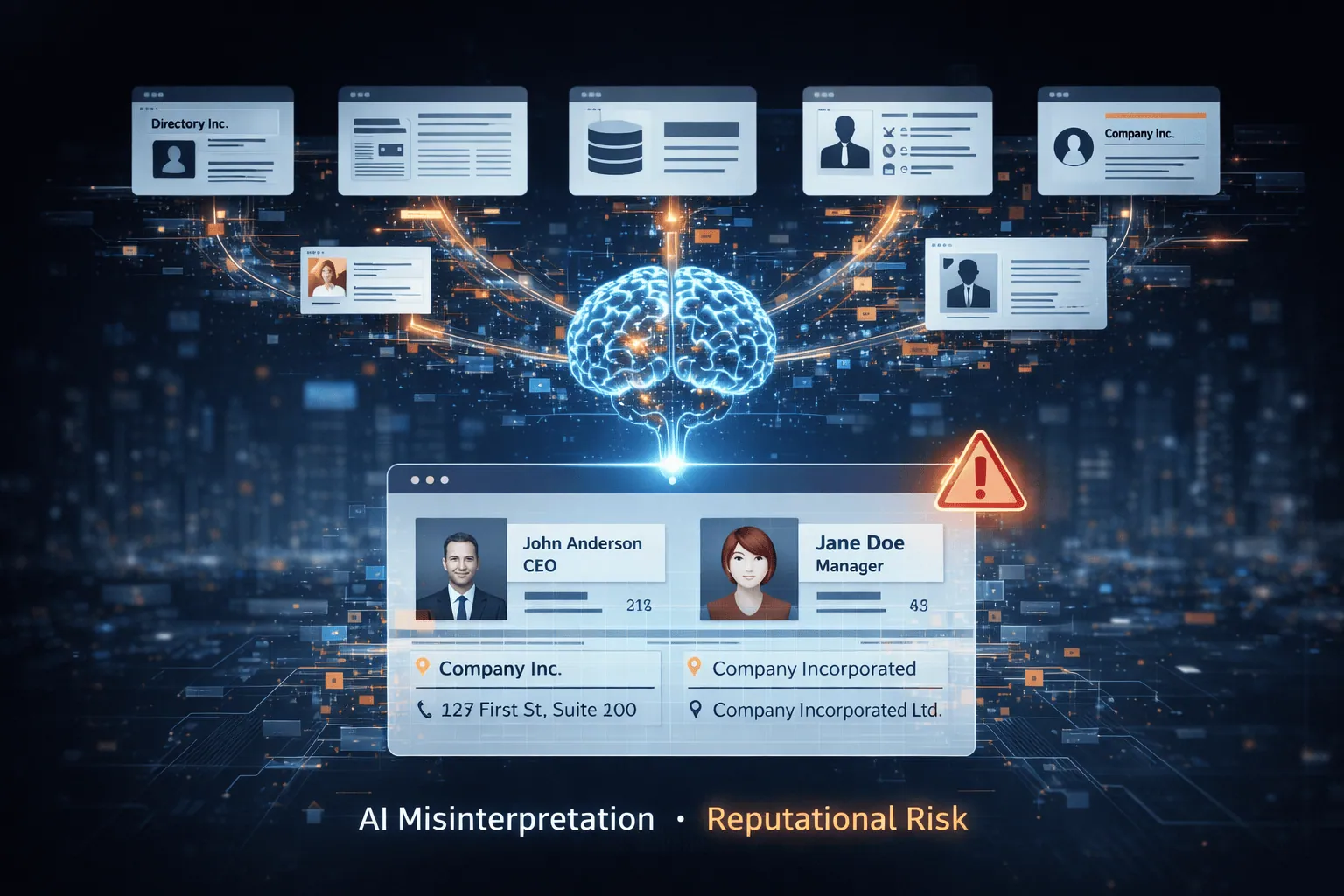 AI systems aggregate signals from:
-
Search engines
-
Third-party databases
-
News coverage and historical content
If those inputs conflict, AI resolves ambiguity using frequency, consensus, and perceived authority, not truth.
Key reality:
You cannot control AI outputs until you control the external data sources AI relies on.
This is not an AI problem.
It is a governance problem.
How External Data Inconsistencies Become Reputational Risk
Across enterprises, the same issues appear repeatedly:
-
Incorrect executive titles or leadership attribution
-
Outdated locations, services, or capabilities
-
Conflicting company descriptions across platforms
-
Mismatched legal entities, DBAs, or brand variants
-
Legacy listings left unmanaged after acquisitions
When these inconsistencies exist, AI synthesizes them into a narrative that reflects what appears most consistent, not what is most accurate.
Your brand becomes whatever the external ecosystem signals most often.
Why This Risk Is Material for Enterprise Organizations
AI-generated summaries now influence:
-
Buyer research and vendor shortlists
-
Analyst evaluations and market positioning
-
Procurement and compliance workflows
-
Recruitment and employer branding
-
Media narratives and due diligence
When AI outputs conflict with reality, enterprises experience:
-
Credibility erosion
-
Slower sales and diligence cycles
-
Confusion during audits or transactions
-
Loss of narrative control at scale
This risk compounds quietly until it surfaces at the worst possible moment.
Why Marketing Alone Cannot Fix This
This is not a marketing execution issue.
Marketing teams:
-
Do not control the legal entity structure
-
Do not govern external data aggregators
-
Cannot enforce consistency across independent systems
IT, legal, communications, and marketing each own pieces of the problem, but no one owns the whole system.
Without executive ownership and formal governance, fragmentation is inevitable, and AI amplifies it.
Our Solution: Enterprise AI & SEO Governance Services
EWR Digital provides enterprise AI & SEO governance services designed to control how machines interpret your organization across search engines, AI platforms, and external data ecosystems.
This is not traditional SEO.
This is an enterprise governance infrastructure.
What Our Governance Services Deliver
1. Entity Unification & Canonical Control
We establish and enforce a single authoritative identity across all machine-readable environments.
-
Corporate entity alignment
-
Brand and sub-brand consolidation
-
Executive and leadership attribution control
2. External Data Ecosystem Alignment
We identify, audit, and correct the third-party data sources that shape AI interpretation.
-
Data aggregator remediation
-
Directory and database alignment
-
Knowledge graph consistency
3. Authority Anchoring
We secure high-trust, editorially governed references that stabilize AI consensus.
-
Authoritative signal reinforcement
-
Reduction of conflicting narratives
-
Long-term authority compounding
4. Defensive Signal Control
We mitigate risks that distort AI interpretation.
-
Impersonation and spoofing prevention
-
Negative signal suppression
-
Conflict amplification mitigation
5. AI Interpretation Monitoring
We monitor how AI systems summarize and represent your organization over time.
-
AI-generated summary audits
-
Drift detection and correction
-
Ongoing governance oversight
Outcomes Enterprises Achieve
Organizations that implement governance experience:
-
Accurate, consistent AI-generated brand summaries
-
Faster buyer and diligence alignment
-
Reduced reputational volatility
-
Stronger executive and leadership visibility
-
Predictable machine interpretation across platforms
Instead of reacting to misinformation, leadership teams shape how machines understand their organization.
Who This Service Is For
This service is designed for organizations that:
-
Operate across multiple brands, entities, or locations
-
Are you preparing for growth, acquisition, or market expansion
-
Are you experiencing inaccurate or inconsistent AI summaries
-
Cannot afford ambiguity during diligence or procurement
-
Require executive-level control over digital representation
If this describes your organization, governance is no longer optional.
Start With an AI & SEO Governance Risk Assessment
Most enterprises do not know how fragmented their external data ecosystem has become.
The first step is visibility.
Request an AI & SEO Governance Risk Assessment to identify:
-
Conflicting entity signals
-
High-risk external data sources
-
AI interpretation inconsistencies
-
Governance gaps across systems
Why EWR Digital
EWR Digital specializes in enterprise-level AI and SEO governance, not campaign-based optimization.
Our engagements operate alongside:
-
Executive leadership
-
Legal and compliance teams
-
IT and data stakeholders
We focus on control, consistency, and authority, not traffic metrics.
Regain Control Over How AI Interprets Your Organization
AI is not dangerous because it is wrong.
It is dangerous because it is confident, even when the data is incomplete.
👉 Ensure your organization is accurately represented during your next audit or acquisition. Call EWR Digital today to secure your canonical identity.
This article was originally published on EWR Digital. Migrated to ModalPoint 2026-05-17 to align with ModalPoint’s AI Governance for Capital-Intensive Industries practice. Author: Matt Bertram, President of ModalPoint.
Frequently Asked Questions
Why does AI confidently present wrong information about my company?
AI systems interpret your organization based on the external data environment surrounding it. When that environment is inconsistent, fragmented, or outdated, AI generated summaries inherit those flaws and present them confidently as facts. AI does not pause for clarification or validate intent, it resolves conflict through inference, and inference is not accuracy.
Can a company control what AI says about its brand?
Not directly. You cannot control AI outputs until you control the external data sources AI relies on. AI aggregates signals from search engines, third party databases, data aggregators, knowledge graphs, and news coverage. If those inputs conflict, AI resolves ambiguity using frequency, consensus, and perceived authority, not truth. It is a governance problem, not an AI problem.
How do external data inconsistencies become reputational risk?
The same issues appear repeatedly: incorrect executive titles, outdated locations or services, conflicting company descriptions, mismatched legal entities or brand variants, and legacy listings left unmanaged after acquisitions. AI synthesizes these into a narrative that reflects what appears most consistent, not what is most accurate. Your brand becomes whatever the external ecosystem signals most often.
Why can marketing alone not fix AI misinterpretation?
Marketing teams do not control the legal entity structure, do not govern external data aggregators, and cannot enforce consistency across independent systems. IT, legal, communications, and marketing each own pieces of the problem, but no one owns the whole system. Without executive ownership and formal governance, fragmentation is inevitable and AI amplifies it.