AI Visibility Checklist for Energy Tech Providers
By Matthew Bertram | ModalPoint
The procurement landscape across the energy corridor has fundamentally transformed, moving away from volume-driven metrics to focus heavily on ROIC and capital discipline. For oilfield technology firms, prioritizing a robust digital information governance program is now the definitive starting point to ensure technical assets are structured correctly. Traditional SEO tactics and gated PDFs are no longer sufficient to secure a spot on an operator’s shortlist; Large Language Models (LLMs) and Generative Engine Optimization (GEO) serve as the primary filters determining which vendor solutions possess the technical depth to bypass procurement purgatory. Technical buyers and energy executives do not search the web like consumers do. They leverage AI engines to find highly specific answers regarding equipment uptime, carbon intensity reduction, and labor efficiency. To remain competitive, your digital footprint must transition from standard marketing copy into high-fidelity, machine-readable intelligence that these models can seamlessly ingest and cite.Why Generalist Marketing Fails the LLM Energy Tech Evaluation
For years, energy tech marketing has suffered from a sea of sameness. Generalist agencies filled websites with empty buzzwords like “transformative,” “cutting-edge,” and “game-changing.” AI engines completely ignore this fluff because it lacks semantic density and technical context. When a CTO asks an LLM for an asset integrity platform compatible with an existing digital twin infrastructure, the engine looks for high-fidelity data points, not marketing hyperbole. To win the battle for AI visibility energy technology providers must optimize for how machines ingest information. This means shifting your content strategy toward deep vertical alignment and data-rich technical documentation. Your website must serve as a repository of clear, structured answers to the complex engineering problems that operators face daily in Upstream, Midstream, Downstream, and Service segments.“As generative AI search engines become the primary interface for technical research, organizations must transition from keyword stuffing to data-rich, semantically accurate documentation to maintain discoverability in industrial markets.” Learn more about machine-readable data architectures on the Gartner Research Portal.
The Oilfield Technology AI Search Optimization Framework
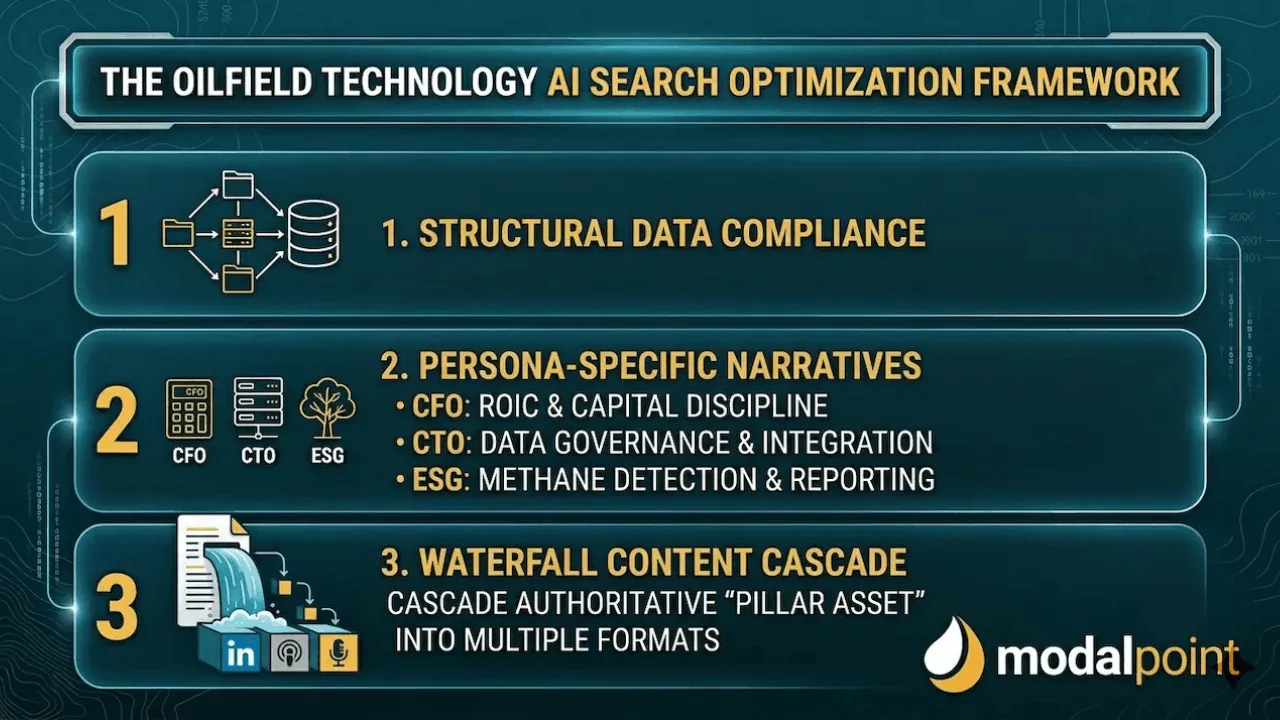
1. Structural Compliance for AI Data Scraping
LLMs have a strong preference for specific data structures. To ensure your technical specs are accurately ingested, you must abandon dense walls of prose in favor of clear tables, structured bullet points, and schema markup. If a machine cannot easily parse your API compatibility or cybersecurity protocols, you will be left out of the AI Overview entirely.2. Speak the Language of the Segment Persona
Your content must be mapped directly to the precise operational drivers of your core buyers rather than general corporate goals:- CFO & Procurement: Focus on capital discipline, reduction of lease operating expenses (LOE), and clear returns on invested capital.
- CTO & IT Directors: Focus on data governance, edge computing maturity, and seamless integration with legacy SCADA systems.
- ESG Officers: Focus on real-time methane detection verification, accurate carbon intensity tracking, and defensible sustainability reporting frameworks.
3. Deploy the Waterfall Content Cascade
Stop creating isolated blog posts that lack depth. Instead, establish an authoritative “Pillar Asset,” such as an in-depth whitepaper on remote oilfield connectivity or a technical webinar hosted alongside the Oil and Gas Global Network. Once this heavy asset is built, cascade it down into targeted solution briefs, localized LinkedIn insights, and highly specific Q&A blocks optimized directly for AI engine synthesis.The Technical Checklist: Engineering Your Site for 2026 AI Search Visibility
Use this functional checklist to audit your current digital assets and ensure your firm ranks at Position Zero in high-intent industrial queries.How do I optimize my energy tech website for AI search engines?
To optimize for AI engines, you must provide direct, factual answers to complex engineering questions, maintain high semantic density, use structured HTML tables for specifications, and align your content with specific operational metrics like ROIC and equipment uptime.What is the role of LLM energy tech data ingestion in procurement?
Modern procurement teams use customized internal LLMs to scan vendor documentation. If your technical architecture, cybersecurity compliance, and integration maturity are not clearly defined in machine-readable formats, the AI will exclude your company from the automated vendor shortlists.| Optimization Layer | Legacy SEO Approach (Obsolete) | 2026 AI Visibility Standard |
|---|---|---|
| Content Style | Keyword-stuffed blog posts filled with industry buzzwords. | High-context, research-backed solution briefs with zero fluff. |
| Formatting | Long paragraphs hidden inside gated, non-scannable PDFs. | Clean HTML headers, clear bulleted summaries, and structured tables. |
| Core Focus | Vague explanations of innovation and technology features. | Quantifiable impact on labor efficiency, carbon intensity, and uptime. |
Essential Action Items for Technical Positioning
- Eliminate Abstract Claims: Replace every instance of “next-generation platform” with explicit performance metrics, such as “reduces unplanned downtime by 14% via predictive edge analytics.”
- Build a Factual Q&A Directory: Create dedicated, non-gated FAQ sections on your product pages. Structure the questions exactly as an operator would ask them inside an AI chat interface.
- Expose Your Integration Maturity: Clearly state your software compatibility parameters, supported communication protocols (e.g., MQTT, OPC UA), and API availability to satisfy the technical requirements of IT directors.
Securing Long-Term Authority in the Energy Sector
Achieving true authority requires a dual approach that bridges both digital and physical ecosystems. While your website must be perfectly optimized for llm energy tech scrapers, your brand voice must also resonate across major offline platforms. Amplifying your leadership through recognized industry channels establishes the offline-to-online validation that modern search engines track to verify real-world credibility. When you combine precise machine readability with established market reputation, you build a digital footprint that cannot be ignored. Stop letting generalist marketing strategies dilute your technical expertise. It is time to transition your content into an enterprise asset that directly influences the automated discovery systems of modern energy buyers. For a comprehensive evaluation of your current B2B positioning and to align your market outreach with rigorous technical standards, partner with the industrial commercialization specialists at ModalPoint.Industrial Market Insight: According to a recent B2B technology procurement analysis by McKinsey & Company, over 70% of industrial buyers now utilize advanced AI-powered search engines and internal LLM tools to conduct initial vendor screening and technical architecture evaluations before making direct contact with a sales representative.
Frequently Asked Questions
Why do energy tech vendors disappear from AI-generated vendor shortlists?
Because AI engines ignore generalist marketing fluff that lacks semantic density and technical context. When a CTO asks an LLM for an asset integrity platform compatible with an existing digital twin, the engine looks for high fidelity data points, not marketing hyperbole. Vendors whose sites lean on buzzwords like transformative and cutting edge get passed over. To see what the engines say about you now, start with an AI Reputation Snapshot.
What makes technical content machine-readable for AI engines?
LLMs prefer clear tables, structured bullet points, and schema markup over dense walls of prose. If a machine cannot easily parse your API compatibility or cybersecurity protocols, you are left out of the AI Overview. Stating supported communication protocols such as MQTT and OPC UA and your API availability satisfies the technical requirements the engines look for.
How should energy tech content map to different buyers?
Map content to the operational drivers of each persona. CFO and procurement care about capital discipline, lower lease operating expense, and clear returns on invested capital. CTO and IT directors care about data governance, edge computing maturity, and integration with legacy SCADA. ESG officers care about real time methane detection, carbon intensity tracking, and defensible sustainability reporting.
Why replace vague claims with specific performance metrics?
AI engines reward quantifiable impact. Replacing a phrase like next generation platform with an explicit figure such as reduces unplanned downtime by 14 percent via predictive edge analytics gives the engine the concrete data point it needs to cite you. McKinsey reports that over 70 percent of industrial buyers now use AI powered search and internal LLM tools to screen vendors before contacting sales.