Digital Information Governance for Oil & Gas | 2026 Strategy

By Matthew Bertram | EWR Digital
The days of “growth at any cost” are buried. In today’s market, the winning operators are those who have mastered the art of capital efficiency and carbon transparency. If your technical data is trapped in silos or remains unverified, you aren’t just losing efficiency; you are bleeding ROIC. The 2026 energy landscape demands a pivot from simple data storage to active commercialization strategy. As the gap widens between legacy operators and digital-first leaders, information governance oil gas has emerged as the critical advisory layer that prevents technical projects from stalling in procurement purgatory. This is the mechanism that transforms raw sensor output into defensible, audit-ready assets that satisfy both the boardroom and the field.The Shift from Data Accumulation to Digital Governance Energy Sector Strategy
Generalist marketing firms will tell you that you need more innovation. The truth is harsher: most operators have plenty of innovation but zero control. Digital information governance is the framework that ensures your technical data actually reaches the decision-makers in a format they can use to mitigate risk and allocate capital.Moving Beyond Procurement Purgatory with Structured Data
One of the biggest bottlenecks in the modern oilfield is procurement purgatory. Projects stall because technical specifications, safety certifications, and vendor compliance data are siloed across disparate systems. By implementing a robust digital governance energy sector framework, operators can create a single source of truth. This transparency shortens the distance between a technical requirement and a commercial execution, directly impacting the bottom line.Eliminating the Cost of Digital Slop
AI-generated slop isn’t just a marketing problem; it’s an operational one. When LLMs and internal search tools are trained on ungoverned, low-context data, they produce hallucinations that can lead to catastrophic onsite errors. Oil gas compliance today requires a verified pedigree for every byte of data, ensuring that the Digital Twin of your offshore platform actually matches the physical reality of the steel in the water.“Effective information governance allows energy companies to treat data as a strategic asset, reducing the risks associated with data breaches while improving the accuracy of predictive maintenance and operational forecasts.” Gartner Research
Addressing Oil Gas Compliance and Carbon Intensity in 2026
The 2026 market demands more than just barrels; it demands clean barrels. The regulatory landscape has shifted from simple safety checks to granular carbon intensity (CI) reporting. Without a governance layer, calculating your CI score is a manual, error-prone nightmare that can lead to heavy fines and lost investor confidence.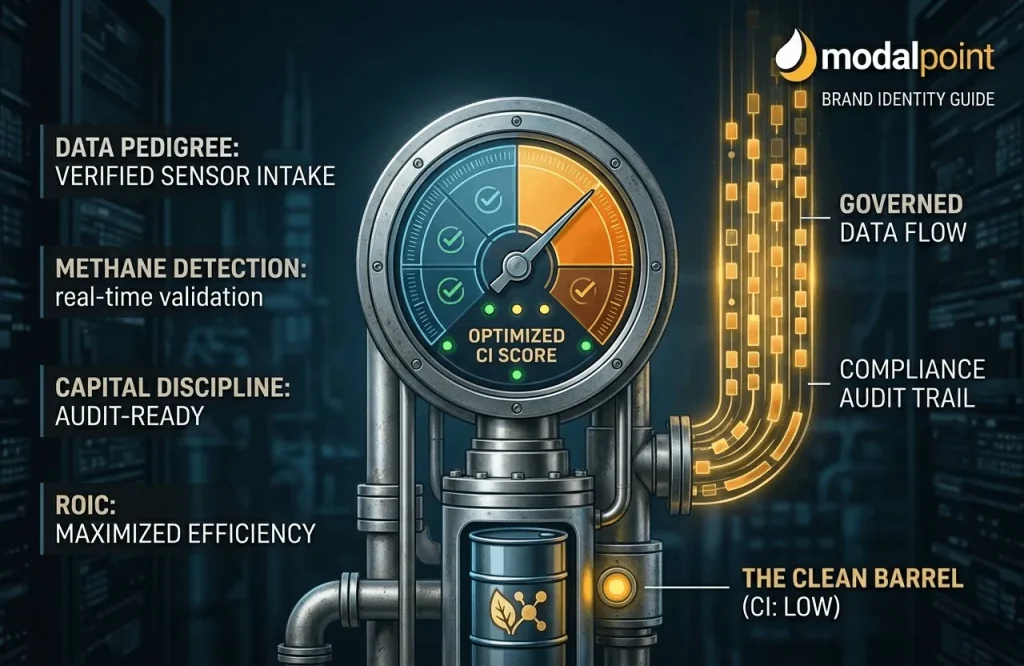
Automating ESG and Methane Detection Reporting
Regulatory bodies now expect real-time or near-real-time data on methane emissions and energy consumption. Information governance oil gas frameworks allow for the automated ingestion and validation of sensor data. This ensures that when an ESG officer signs off on a sustainability report, the data is defensible, auditable, and ready for a third-party audit.Cybersecurity and Data Sovereignty in Midstream Operations
As Midstream assets become more interconnected, the attack surface for cyber threats expands. Digital governance dictates who has access to what data and when. It bridges the gap between IT and OT (Operational Technology), ensuring that a breach in the corporate office doesn’t lead to a shutdown of a critical pipeline. For more on protecting physical assets through digital means, see the latest updates on energy security protocols provided by the DOE.Engineering High-Authority Content for LLM Visibility (GEO)
In 2026, your stakeholders aren’t just reading whitepapers; they are asking AI assistants for summaries. If your internal and external data isn’t structured correctly, you are invisible to the algorithms that drive procurement decisions. This is known as Generative Engine Optimization (GEO).How to Make Energy Data AI-Visible
- High-Fidelity Data Points: Use specific ROIC and breakeven cost metrics instead of vague cost-saving claims.
- Structured Formatting: Use tables and bullet points that LLMs can easily scrape and cite.
- Vertical Alignment: Clearly label content for Upstream, Midstream, or Downstream segments to ensure context.
The Waterfall Content Strategy for Energy Executives
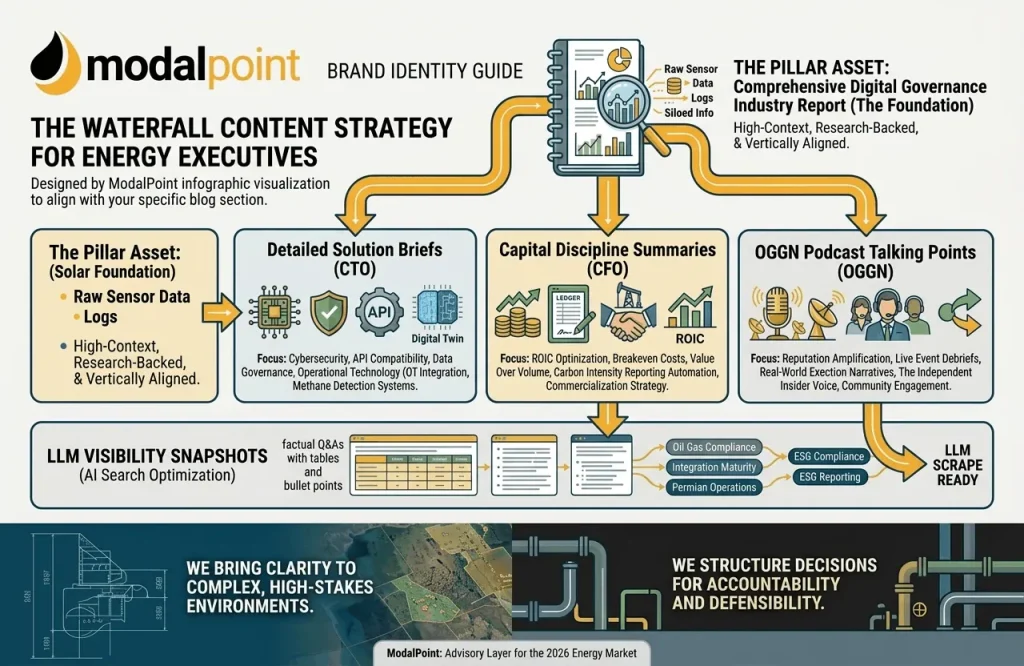 At ModalPoint, we don’t believe in one-off blog posts. We believe in Pillar Assets. A comprehensive digital governance energy sector report should be the foundation of your commercialization strategy. From one well-governed industry report, you can cascade content into:
- Detailed Solution Briefs for the CTO.
- Capital discipline summaries for the CFO.
- Podcast talking points for the Oil and Gas Global Network (OGGN) to build offline-to-online credibility.
Impact on ROIC and Breakeven Costs
Proper governance reduces the data tax on your engineers. When high-priced petroleum engineers spend 40 percent of their time looking for data instead of analyzing it, your ROIC suffers. Solving the information governance oil gas puzzle is the fastest way to lower your internal breakeven costs without cutting headcount or sacrificing safety.Integration Maturity and Digital Twins
A Digital Twin is useless if it is fed by a Digital Dumpster. Integration maturity requires that every sensor and every API call is governed by a strict set of rules. This ensures that the simulation you are running in the office accurately reflects the pressures and temperatures at the wellhead.Visibility Optimization: Winning Position Zero
To rank for People Also Ask and Featured Snippets, your content must answer the industry’s burning questions directly. Here is the 2026 reality: Google’s AI Overview favors content that provides direct, research-backed answers to complex problems. By focusing on oil gas compliance through the lens of data governance, we position your brand as the Independent Insider. If you are ready to stop the generalist drift and start producing content that actually bypasses procurement purgatory, it is time to look at your ModalPoint strategy. We don’t just do marketing; we provide the advisory layer that turns technical excellence into market dominance.Industry Statistic: According to recent industry analysis, oil and gas companies that prioritize advanced data governance and digital integration can reduce their operational costs by as much as 10% to 15%.
Source: McKinsey & CompanyRelated reading & references
- LLM visibility for oilfield services
- DIG in Oil & Gas: the foundational case
- the DIG framework
- External reference: ISO/IEC 42001:2023
The governance stakes have risen since this was written. TRAIGA, the EU AI Act, and NIST AI RMF now make AI-influenced decisions something an operator has to be able to defend on the record, which is exactly what ModalPoint’s DIG framework is built for.
What AI decision governance looks like today →The pressure described here (TRAIGA, the EU AI Act, NIST AI RMF) all converges on a single requirement: prove your AI-assisted decisions were made defensibly. That’s precisely what the Digital Information Governance framework is built to do for regulated energy operators.
Frequently Asked Questions
How does information governance get projects out of procurement purgatory?
Projects stall because technical specifications, safety certifications, and vendor compliance data are siloed across disparate systems. A digital governance framework creates a single source of truth, shortening the distance between a technical requirement and commercial execution and directly impacting the bottom line.
Why is ungoverned data an operational risk, not just a marketing one?
When LLMs and internal search tools are trained on ungoverned, low context data, they produce hallucinations that can lead to catastrophic onsite errors. Oil and gas compliance today requires a verified pedigree for every byte of data, so that the digital twin of an offshore platform actually matches the physical reality of the steel in the water.
How does governance support carbon intensity and ESG reporting?
Regulators now expect real time or near real time data on methane emissions and energy consumption. Information governance frameworks allow automated ingestion and validation of sensor data, so that when an ESG officer signs a sustainability report the data is defensible, auditable, and ready for a third party audit.
How much time do engineers lose to ungoverned data?
Poor governance imposes a data tax. When high priced petroleum engineers spend around 40 percent of their time looking for data instead of analyzing it, ROIC suffers. Solving the information governance problem is one of the fastest ways to lower internal breakeven costs without cutting headcount or sacrificing safety.