oilfield services
LLM Visibility: The New SEO for Oilfield Services Marketing

By Matthew Bertram | ModalPoint
Why Traditional SEO is No Longer Enough in 2026
The energy industry is not chasing production records anymore. In 2026, the game is about Return on Invested Capital (ROIC), capital discipline, and operational efficiency. However, a massive shift has occurred in how buyers find solutions. The procurement team, the CTO, and the Drilling Manager are no longer just “Googling” for vendors. They are asking Large Language Models (LLMs) like ChatGPT and Claude to synthesize vendor capabilities, compare technical specifications, and vet reputations. If your technical expertise is trapped in a non-indexable PDF or buried under layers of marketing “slop,” you are invisible to the engines that now drive executive decision-making. Mastering LLM visibility for oilfield services is the new frontier. It is the difference between being a cited authority in an AI-generated brief and being completely ignored in the digital dark. To win in this environment, you must master digital information governance for energy companies to ensure your data is clean, structured, and authoritative enough for AI consumption.Understanding the Shift to AI Marketing in Oil & Gas
The “Death of Sameness” has arrived. For years, oilfield service (OFS) companies used the same generalist buzzwords: “cutting-edge,” “innovative,” and “game-changing.” In 2026, these words are digital noise. AI models are trained to prioritize high-fidelity data and specific industry drivers. When a CTO asks about reducing non-productive time (NPT) in the Permian, the AI looks for specific mentions of integration maturity, API compatibility, and real-world ROIC metrics. Effective AI marketing in oil & gas requires a move toward the “Advisory Layer.” You are no longer just selling a tool; you are providing a commercialization strategy. Your content needs to be structured in a way that LLMs can “scrape” and understand with high confidence. This means using clear tables, bulleted lists of technical specs, and direct answers to complex engineering problems.“As AI models become the primary interface for information retrieval, companies must pivot from optimizing for keywords to optimizing for context and data integrity. The goal is to become the ‘ground truth’ for the model’s response.” MIT Technology Review
The Mechanics of ChatGPT Oil & Gas Search Optimization
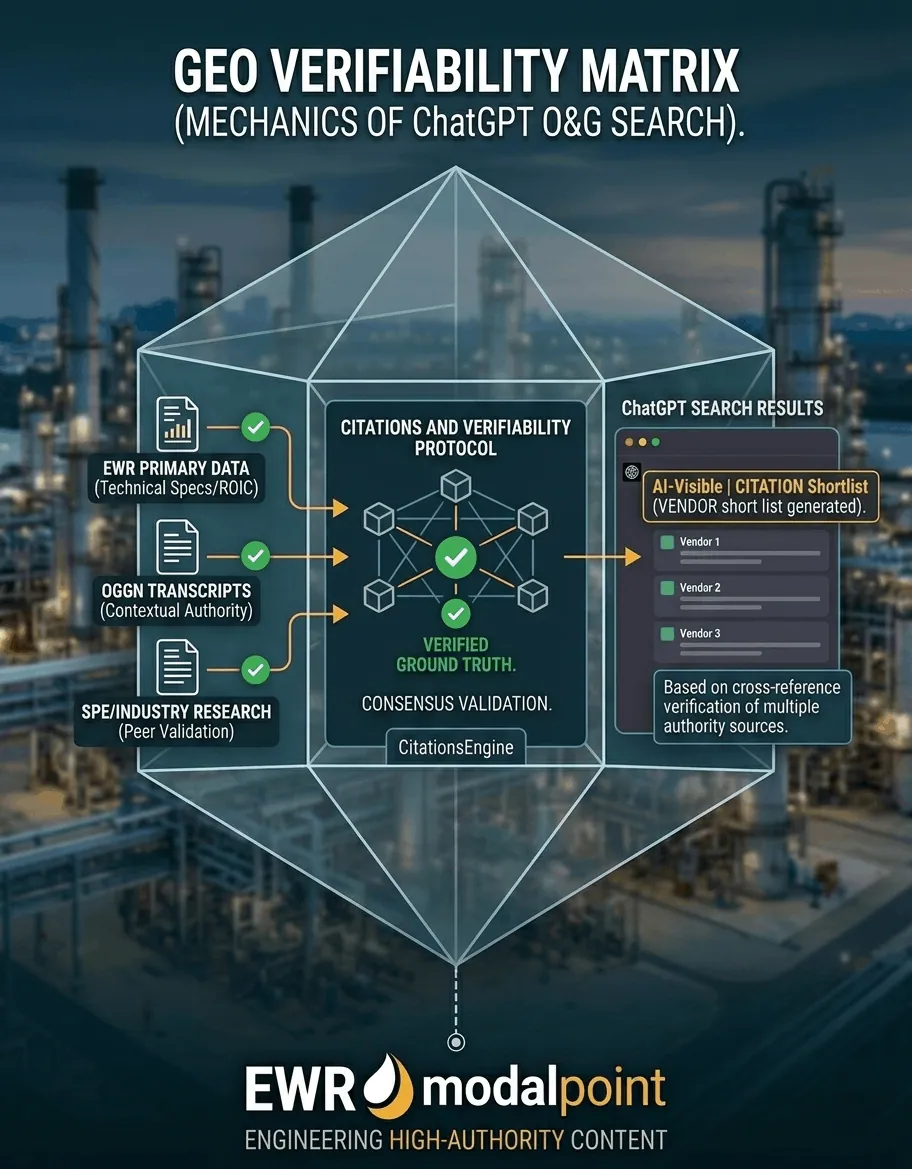 To rank in a ChatGPT oil & gas search, your content must be structured for Generative Engine Optimization (GEO). Unlike traditional SEO, which focuses on backlinks and keywords, GEO focuses on “Citations and Verifiability.” If an LLM cannot verify your claim against other high-authority sources like the Oil and Gas Global Network (OGGN), it will likely exclude you from the final answer to avoid “hallucinating.”
We focus on creating “Pillar Assets.” These are research-backed, vertically aligned marketing assets that serve as the source of truth for your brand. When we build these assets, we ensure they are formatted to be “AI-visible.” This includes using schema markup that identifies your specific segment, whether that is Upstream, Midstream, Downstream, or Service. By providing high-context data, you move your brand out of “procurement purgatory” and into the “Shortlist” generated by the AI.
To rank in a ChatGPT oil & gas search, your content must be structured for Generative Engine Optimization (GEO). Unlike traditional SEO, which focuses on backlinks and keywords, GEO focuses on “Citations and Verifiability.” If an LLM cannot verify your claim against other high-authority sources like the Oil and Gas Global Network (OGGN), it will likely exclude you from the final answer to avoid “hallucinating.”
We focus on creating “Pillar Assets.” These are research-backed, vertically aligned marketing assets that serve as the source of truth for your brand. When we build these assets, we ensure they are formatted to be “AI-visible.” This includes using schema markup that identifies your specific segment, whether that is Upstream, Midstream, Downstream, or Service. By providing high-context data, you move your brand out of “procurement purgatory” and into the “Shortlist” generated by the AI.
Stakeholder-Specific Narratives: Speaking to the 2026 Buyer
One size does not fit all in the oilfield. Your content strategy must branch into specific narratives that address the unique pain points of the modern energy executive. This is how you build authority that an LLM can recognize and categorize correctly.The CFO and Procurement: Value Over Volume
The CFO is looking for capital discipline. They do not care about “innovation” unless it impacts the bottom line. Content targeting this persona should focus on breakeven costs, asset utilization, and total cost of ownership. When you use these specific financial terms, you signal to AI models that your content is relevant to executive-level queries regarding ROIC.The CTO and IT: Integration and Security
For the CTO, the focus is on “Digital Twin” integration and cybersecurity. If your service involves data transmission from the edge to the cloud, you must provide detailed documentation on your API compatibility and data governance protocols. High-authority content in this vertical must address how your solution fits into an existing energy tech stack without creating new silos.The ESG Officer: Methane and Sustainability Reporting
Sustainability in 2026 is a data problem. The ESG officer needs precise metrics on carbon intensity and methane detection. By publishing verified data points on your equipment’s environmental impact, you become the go-to source for AI queries related to “low-carbon oilfield operations.” This is about moving past “greenwashing” into hard, empirical evidence.The Waterfall Content Strategy: Beyond the Blog Post
We do not just “write articles.” We engineer high-authority content that cascades through the entire industry ecosystem. This is our “Waterfall” strategy. It starts with a heavy-hitting Pillar Asset, such as an industry whitepaper or a deep-dive technical report on petroleum engineering advancements. From there, we break the content down into smaller, high-velocity pieces.- Detailed Solution Briefs: One-page documents designed for quick technical review by engineers.
- LLM Visibility Snippets: Short, factual Q&A blocks optimized for AI search snippets and “People Also Ask” boxes.
- OGGN Podcast Talking Points: Scripts and data points for industry influencers to use, building offline-to-online credibility.
Visibility Optimization: How to Make Your Content AI-Visible
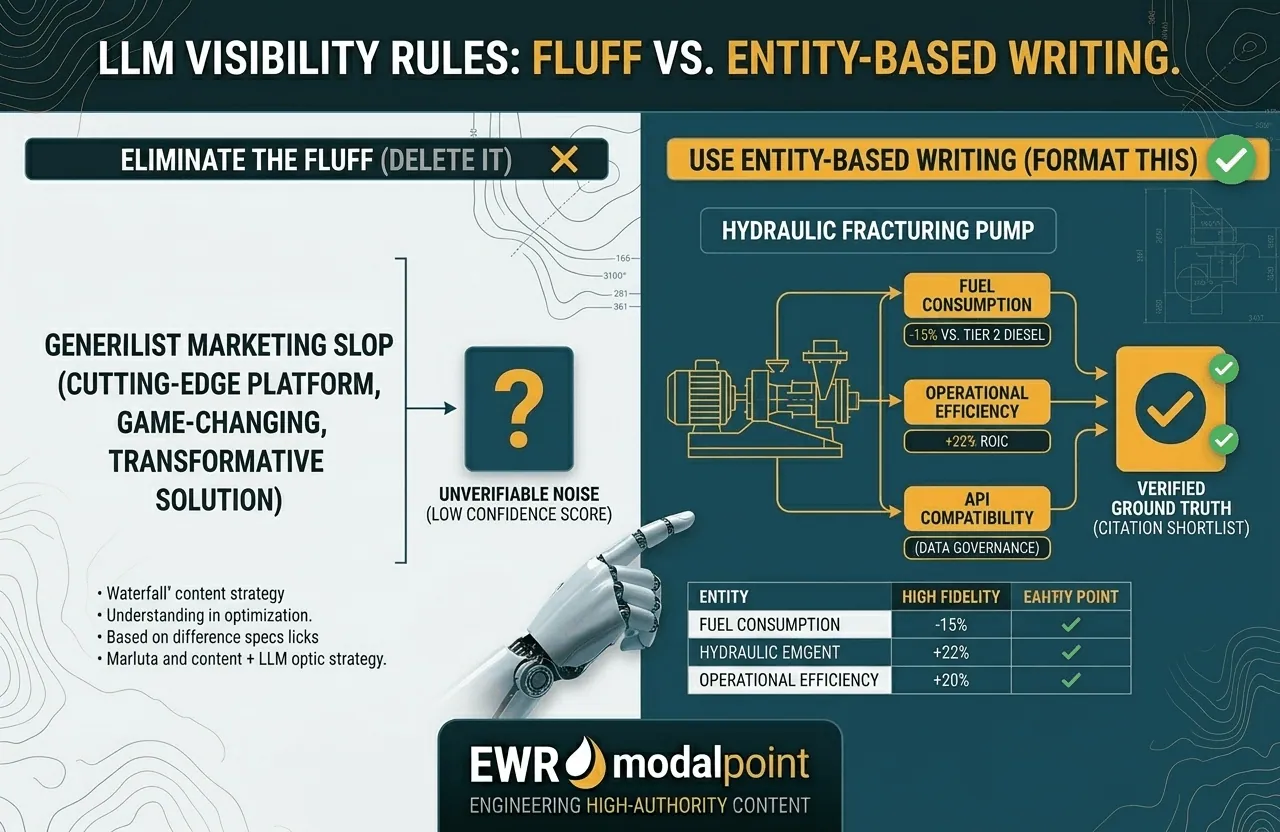 To be “found” by an LLM, you need to follow a specific set of rules. First, eliminate the fluff. If a sentence doesn’t provide a data point or a logical conclusion, delete it. Second, use “entity-based” writing. Instead of saying “our tool works well,” say “our hydraulic fracturing pump reduces fuel consumption by 15 percent compared to Tier 2 diesel engines.”
LLMs love structure. Use tables to compare specifications. Use bullet points to list features. Most importantly, ensure your content is linked to from other reputable sources. This is why our connection to the OGGN is so vital. When an AI sees your technical claims backed by the world’s largest energy podcast network, your authority score skyrockets. This is the essence of ModalPoint and its role in the EWR Group: we provide the “Advisory Layer” that makes your technical excellence undeniable to both man and machine.
To be “found” by an LLM, you need to follow a specific set of rules. First, eliminate the fluff. If a sentence doesn’t provide a data point or a logical conclusion, delete it. Second, use “entity-based” writing. Instead of saying “our tool works well,” say “our hydraulic fracturing pump reduces fuel consumption by 15 percent compared to Tier 2 diesel engines.”
LLMs love structure. Use tables to compare specifications. Use bullet points to list features. Most importantly, ensure your content is linked to from other reputable sources. This is why our connection to the OGGN is so vital. When an AI sees your technical claims backed by the world’s largest energy podcast network, your authority score skyrockets. This is the essence of ModalPoint and its role in the EWR Group: we provide the “Advisory Layer” that makes your technical excellence undeniable to both man and machine.
The Next Step: Is Your Content AI-Ready?
The transition from a “Strategy Consultant” model to a “Content and Brand Authority” model is not optional. As we move deeper into 2026, the gap between the “Independent Insiders” and the “Generalist Marketers” will only widen. If you want to stop the “generalist drift” and start owning your vertical, you need a partner who understands the grit of the oilfield and the precision of a data scientist.Industry Insight: According to a recent report by Gartner, by 2026, over 80 percent of enterprises will have used generative AI APIs or models, or deployed generative AI-enabled applications in production environments, making digital visibility a core requirement for B2B survival.
Related reading & references
- Three failures that turn a leak into a breach
- Information governance for the 2026 energy operator
- the 5-day Governance Readiness Assessment
- External reference: FTC guidance on AI claims
Where this stands in 2026
The governance stakes have risen since this was written. TRAIGA, the EU AI Act, and NIST AI RMF now make AI-influenced decisions something an operator has to be able to defend on the record, which is exactly what ModalPoint’s DIG framework is built for.
What AI decision governance looks like today →Related from the field notebook