Microsoft Agent 365 vs. AI Decision Governance
TL;DR
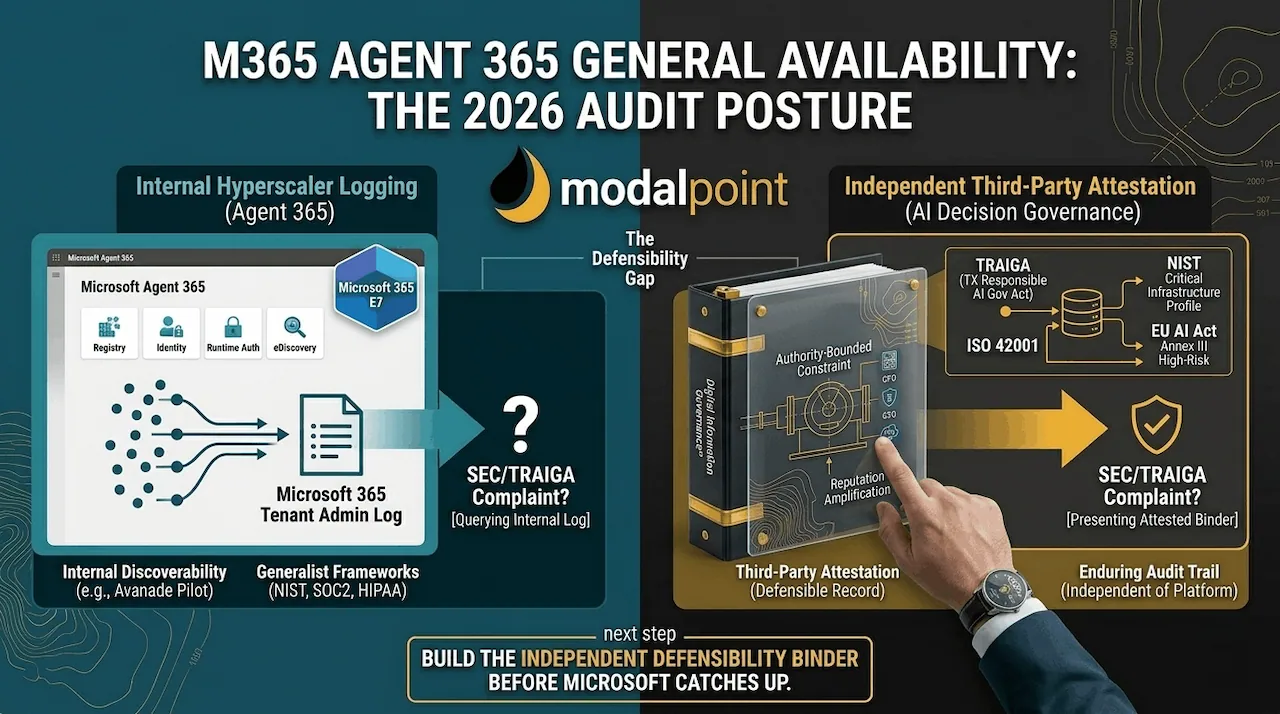
On May 1, 2026, Microsoft made Agent 365 generally available, a $15-per-seat-per-month control plane for AI agents that includes registry, identity, runtime authorization, eDiscovery, and AWS + Google Cloud sync. Bundled into Microsoft 365 E7 at $99 per seat, it will become the default agent-governance answer most enterprises hear about first. For most low-stakes, Microsoft-hosted agents (HR copilots, sales-pipeline summarizers, IT troubleshooters), Agent 365 is the right answer. It’s serious infrastructure, well-priced, and Microsoft will iterate on it for years. For high-stakes operational decisions in regulated industries, it does not solve the problem. Three structural reasons:- Microsoft cannot be your independent third party. Agent 365’s audit trail is internal Microsoft 365 discoverability. When the SEC, an energy regulator, or a board asks “who authorized this AI decision, and who else can attest to it,” a vendor’s internal log is the wrong instrument.
- Microsoft does not yet cover regulated-industry frameworks. The Agent Governance Toolkit’s compliance maps cover NIST AI RMF (general), EU AI Act, SOC2, HIPAA, OWASP, and Colorado AI Act. They do not yet map TRAIGA (Texas Responsible AI Governance Act), the NIST AI RMF Critical Infrastructure Profile, or ISO 42001. Those are the frameworks energy and infrastructure operators are about to be measured against.
- No regulated-industry pilots disclosed. Across Microsoft’s Agent 365 launch materials, only one named pilot customer appears: Avanade, Microsoft’s own consulting subsidiary. No energy operator. No PE-backed industrial. No critical-infrastructure pilot.
What Microsoft Actually Shipped
Microsoft’s agent governance is a four-layer paid platform, not a single product:| Layer | Product | Price | What It Does |
|---|---|---|---|
| 1. Open-source SDK | Agent Governance Toolkit (April 2, 2026) | Free, MIT | Sub-millisecond runtime policy enforcement; 10/10 OWASP Agentic Top 10 coverage; 5-language SDKs |
| 2. Identity | Microsoft Entra Agent ID (Preview) | Bundled into Agent 365 | Per-agent Entra identity; PEP/PDP runtime authorization with ALLOW / DENY / REQUIRE_APPROVAL / MASK |
| 3. Control plane | Microsoft Agent 365 | $15/user/mo, GA May 1, 2026 | Agent registry, observability, governance dashboards, eDiscovery, AWS + Google sync |
| 4. Bundle | Microsoft 365 E7 | $99/user/mo | E5 + Copilot + Entra Suite + Agent 365: all-in enterprise SKU |
What Microsoft Now Claims (and Why It Matters)
The most important shift since the April 2 toolkit announcement is in vocabulary. Microsoft’s Authorization Fabric documentation now uses the exact identity-vs-decision distinction that defines the AI Decision Governance category:“OAuth and API permissions answer ‘can the agent call this API?’ They do not answer ‘should the agent execute this action under business policy, compliance constraints, data boundaries, and approval thresholds?'”That is the right framing. Microsoft has named the gap correctly. They have shipped runtime authorization, per-agent identity, and audit pipelines that capture what agents do. What Microsoft has not yet done is solve the defensibility problem: the problem operators face when an outside party (a regulator, plaintiff’s counsel, an independent auditor, a board’s risk committee) asks not what an agent did, but on whose authority and against which framework.
The Three Things Microsoft Structurally Cannot Do
1. Microsoft cannot be your independent third party
Agent 365’s audit trail is internal discoverability: search and review inside the Microsoft 365 tenant. That is the right architecture for resolving Microsoft-internal incidents. It is the wrong instrument for the question:“Independent of the agent platform vendor, who authorized this AI decision, against which policy, with what defensible reasoning, and who else can attest to it under legal pressure?”When the SEC asks. When the Texas Attorney General’s Section 552.057 complaint comes in (the Texas portal has been open since September 1, 2026). When a portfolio company’s GP demands a defensibility memo before a CIM goes to potential acquirers. When a board’s risk committee requires documentation for D&O coverage. The cleanest version of that audit trail comes from a vendor-independent third party. Microsoft is, by definition, in the chain. This is structural. Any hyperscaler that runs your agents cannot also be the independent auditor of those same agents’ decisions. Adding more Microsoft logging does not solve the problem. The problem is the vendor relationship itself.
2. Microsoft does not yet cover the frameworks regulated operators face
The Agent Governance Toolkit ships with compliance maps for: NIST AI RMF (general), EU AI Act, SOC2, HIPAA, OWASP Agentic Top 10, Colorado AI Act. It does not yet ship maps for the frameworks energy, oil & gas, and critical-infrastructure operators are about to be measured against:- TRAIGA (Texas Responsible AI Governance Act, August 2026): Texas-specific intent standard, Section 552.056(c), the Texas AG complaint portal opening September 1, 2026
- NIST AI RMF Critical Infrastructure Profile: the federal framework specifically for the 16 CI sectors including energy
- ISO 42001: the international AI management system standard most cross-border industrial operators will end up needing
- EU AI Act high-risk obligations under Annex III, applicable from December 2, 2027, with a different evidence standard than the toolkit’s general EU AI Act mapping
3. No regulated-industry pilots disclosed
Across Microsoft’s official Agent 365 launch materials and the May 2026 TechCommunity update, exactly one customer pilot is named: Avanade, Microsoft’s own consulting subsidiary. Zero energy operators. Zero PE-backed industrial firms. Zero critical-infrastructure pilots. Zero regulated-services examples. This will change. But for the operator deciding whether Microsoft’s stack satisfies a 2026 audit, the absence of named regulated-industry references is not a small detail. It means the framework, the binder, and the regulator-facing artifacts are still being written by whoever is implementing first. Most operators do not want to be in the role of writing Microsoft’s regulated-industry implementation playbook on their own audit timeline.Where Microsoft Is the Right Answer
To be clear about the boundary: for the broad category of low-stakes, Microsoft-hosted agents (HR copilot, sales-pipeline summary, IT triage, knowledge-base assistance, customer-service drafting, internal-document search), Agent 365 is the right answer. The pricing is reasonable. The integration with the existing Microsoft tenant is clean. The runtime authorization model is sound. The eDiscovery integration is mature. If your AI use cases are inside the Microsoft tenant, governed by Microsoft policy, audited by your Microsoft team, and the consequences of a wrong decision are internal, Agent 365 is well-priced infrastructure for that problem. That is roughly two-thirds of agent activity in most enterprises. Microsoft will own that two-thirds. They have earned it.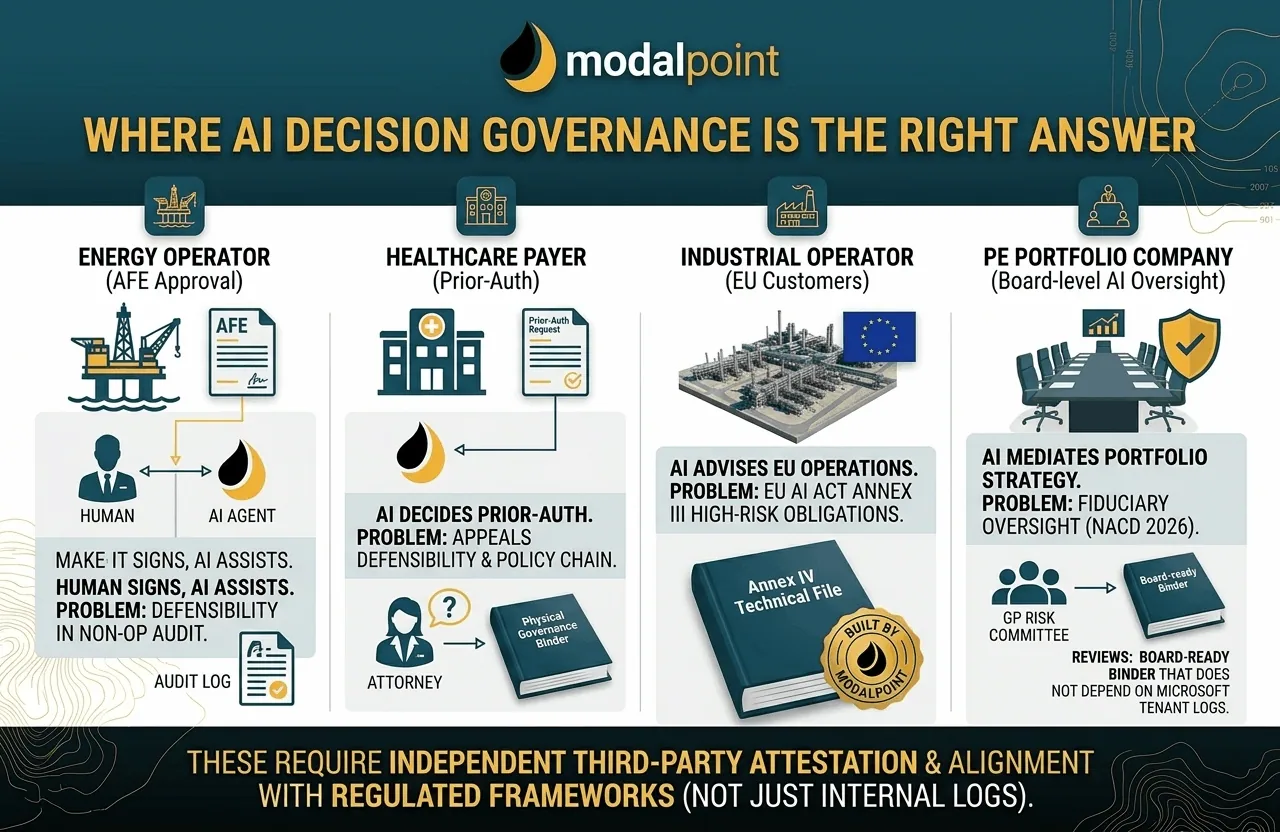
Where AI Decision Governance Is the Right Answer
The remaining one-third (the AI decisions where being wrong costs real money, real regulatory exposure, real D&O liability, real board-level scrutiny) is a different problem. Examples from the operator conversations we run:- Energy operator approving an AFE (Authorization for Expenditure) with AI-assisted economics. The decision is signed by a human, but if the AI inputs are challenged in a non-op partner audit two years later, the question is not “did Copilot recommend this” but “what authority structure was the AI operating under, who validated the assumptions, and where is the defensible record.”
- Healthcare payer running prior-auth with agentic AI. The CMS interim final rule on prior-auth requires defensibility against denial appeals. An internal Microsoft log is not the artifact a denied claim’s appeals attorney is going to subpoena. The artifact is the prior-authorization governance binder, the policy authority chain, and the third-party-attested decision log.
- Industrial operator with EU customers subject to the EU AI Act Annex III high-risk obligations effective December 2, 2027. The Annex IV technical file is a specific document with specific contents. Microsoft does not produce it for you. Your law firm produces a memo about it. Someone has to actually build it.
- PE portfolio company under board-level AI oversight. The board is on the hook for fiduciary AI oversight (NACD 2026 Governance Outlook: 23% of boards have actually assessed AI exposure). An audit trail that requires a Microsoft tenant administrator to produce is not the audit trail the GP’s risk committee wants to rely on.
The Two Categories Will Coexist
The clearest analogy is the cybersecurity stack as it evolved between 2010 and 2020. Microsoft, AWS, and Google all eventually shipped strong cloud-native security primitives: IAM, audit logging, encryption, threat detection. That did not eliminate the independent security audit, the SOC2 attestation, the third-party penetration test, the IR firm on retainer. Those categories grew alongside hyperscaler-native security. The same pattern is reasonable to expect for AI agent governance. Hyperscaler-native control planes (Microsoft Agent 365, Google Cloud’s Agent Identity + Agent Gateway, AWS’s eventual answer) will own most agent activity at scale. Independent, vendor-neutral, regulated-industry-specific decision governance practices will sit alongside them, handling the AI decisions that have to be defensible to auditors, regulators, courts, and boards. Both categories will exist. Operators in regulated industries will need both.The Question to Take Back to Your Team
Before assuming Microsoft Agent 365 satisfies your AI governance obligations, the question to take back to your team is:When a regulator, a board’s risk committee, an opposing counsel, or an independent auditor asks who authorized this AI decision and against which framework, what artifact do we hand them, and is it the kind of artifact that holds up when read by someone who does not work for Microsoft?If the answer is “the Agent 365 audit log we exported from our M365 admin console,” the next question is whether that satisfies a TRAIGA Section 552.057 complaint, an EU AI Act Annex IV technical file requirement, or a Caremark fiduciary defense. If the answer is “we have a third-party-attested decision governance binder built against our specific regulatory framework, and the Microsoft tools are part of how we operate it day-to-day,” that is the right shape. The first answer is what Microsoft sells. The second answer is what we build.
Sources
- Microsoft Open Source Blog (April 2, 2026 toolkit announcement)
- GitHub
microsoft/agent-governance-toolkitv3.3.0 - Microsoft Cloud Adoption Framework: Governance and Security for AI Agents Across the Organization (April 9, 2026)
- Microsoft Security Blog: Authorization and Governance for AI Agents (PEP/PDP architecture document)
- Microsoft 365 Blog: Charles Lamanna, Agent 365 launch (November 2025)
- TechCommunity: What’s New in Agent 365: May 2026
- VentureBeat, SAMexpert, InfoWorld coverage
- ModalPoint internal analysis of regulated-industry framework gaps (TRAIGA, NIST AI RMF Critical Infrastructure Profile, ISO 42001)
Author
Matthew Bertram is President of ModalPoint, an AI Decision Governance practice for regulated industries, and CEO of EWR Digital. He is a member of NIST’s Cyber AI Profile and Zero Trust Communities of Interest, a Goldman Sachs 10,000 Small Businesses graduate (April 2026), and the moderator of the Ericsson AI panel at Offshore Technology Conference 2026 (May 4, 2026). Provisional patents filed: “Governance Control Plane Systems and Methods for Enforcing Authority-Bounded Constraints on Autonomous Artificial Intelligence Agent Execution in Regulated Environments”; “Computer-Implemented Systems and Methods for Automated Quantification and Governance of AI-Mediated Decision Risk.” Digital Information Governance® is a U.S. trademark (USPTO Reg. No. 8147558) of ModalPoint.Where to Start
If you’re an operator at a regulated firm and you’re not yet sure how much shadow AI is already running inside your organization, that’s the question worth answering first. ModalPoint runs a 3-week, $2,500 Shadow AI Exposure Assessment that surfaces unsanctioned AI usage, classifies the exposure, and gives you a defensible 60-day remediation roadmap. It’s the lowest-friction first step into the ModalPoint engagement ladder, and the assessment fee credits toward Texas Ready or the Cross-Border Governance Binder if the exposure warrants the deeper work. Learn about the Shadow AI Exposure Assessment →Related reading & references
- Running an AI audit in oil & gas
- LLM visibility for oilfield services
- ModalPoint
- External reference: MIT CSAIL AI research
The governance stakes have risen since this was written. TRAIGA, the EU AI Act, and NIST AI RMF now make AI-influenced decisions something an operator has to be able to defend on the record, which is exactly what ModalPoint’s DIG framework is built for.
What AI decision governance looks like today →Frequently Asked Questions
Does Microsoft Agent 365 satisfy AI governance obligations for regulated industries?
For low stakes, Microsoft hosted agents such as HR copilots, sales summaries, and IT troubleshooters, Agent 365 is the right answer. For high stakes operational decisions in regulated industries it does not solve the problem, for three structural reasons: Microsoft cannot be your own independent third party, its toolkit does not yet map TRAIGA, the NIST AI RMF Critical Infrastructure Profile, or ISO 42001, and no regulated industry pilots have been disclosed.
Why can a platform vendor not be your independent AI auditor?
Any hyperscaler that runs your agents cannot also be the independent auditor of those same agents decisions. Agent 365’s audit trail is internal Microsoft 365 discoverability, which is the right tool for internal incidents but the wrong instrument when a regulator, opposing counsel, or a board risk committee asks, independent of the platform vendor, who authorized this AI decision and who else can attest to it. The problem is the vendor relationship itself.
When is AI decision governance the right answer instead of a platform tool?
When being wrong carries real money, regulatory exposure, D&O liability, or board scrutiny. Examples include an energy operator approving an AFE with AI assisted economics, a healthcare payer running prior authorization with agentic AI, an industrial operator subject to EU AI Act high risk obligations, and a PE portfolio company under board level AI oversight. These require independent third party attestation, regulated industry framework alignment, and a defensibility record that does not depend on one vendor’s tooling.
Will hyperscaler tools and independent governance coexist?
Yes. The clearest analogy is the cybersecurity stack between 2010 and 2020, where hyperscalers shipped strong cloud native security primitives yet the independent audit, the SOC 2 attestation, and the third party penetration test grew alongside them. Hyperscaler native control planes will own most agent activity at scale, and independent, vendor neutral, regulated industry decision governance will sit alongside them. Operators in regulated industries will need both.