AI Audit for Oil & Gas: 2026 Governance & Risk Assessment
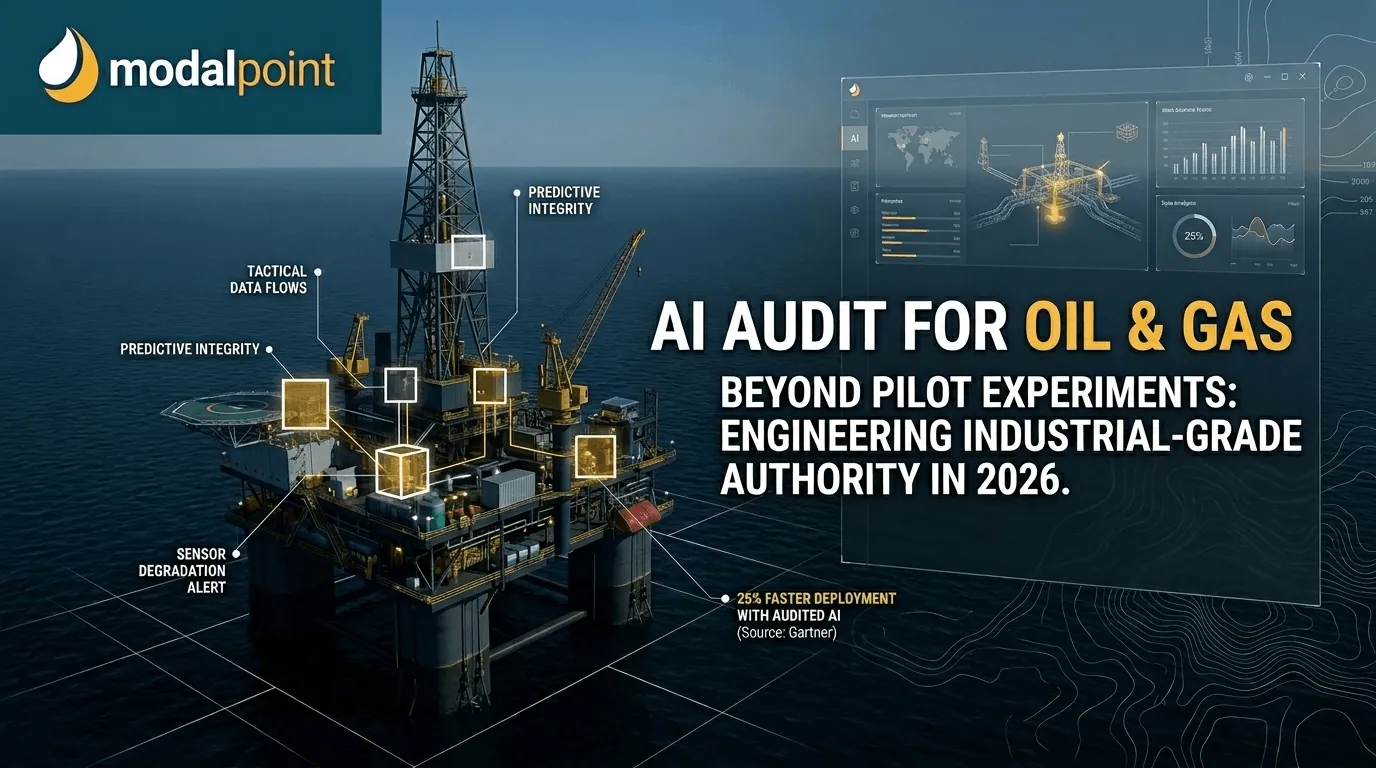
By Matthew Bertram | ModalPoint
The era of “experimenting” with Large Language Models in the oil patch is officially over. We have entered the era of capital discipline and operational accountability. In 2026, the industry is no longer chasing the novelty of generative AI; it is chasing Return on Invested Capital (ROIC) and the mitigation of catastrophic data leaks. If your AI strategy is not audited, it is not a strategy; it is a liability.The Shift from Generative Hype to Industrial Accountability
For the last few years, the energy sector has been flooded with generalist AI tools promising to revolutionize everything from seismic imaging to cafeteria menus. Most of it was “slop”: unstructured, unverified, and disconnected from the harsh realities of the field. Today, the boardrooms of Houston and Aberdeen are asking tougher questions. They want to know where the data comes from, who owns the weights of the model, and how these systems affect digital information governance within their private clouds. An AI audit for oil gas is the process of evaluating your automated systems for accuracy, safety, and compliance. It is the bridge between a pilot project and a full-scale deployment that actually moves the needle on barrel-per-day efficiency or methane reduction. Without an audit, you are essentially flying a drone into a sandstorm without GPS. The generalist drift has led many firms to deploy “black box” solutions that look good in a slide deck but fail the moment they encounter the non-linear variables of a high-pressure, high-temperature (HPHT) environment.What Exactly is an AI Audit in the Energy Sector?
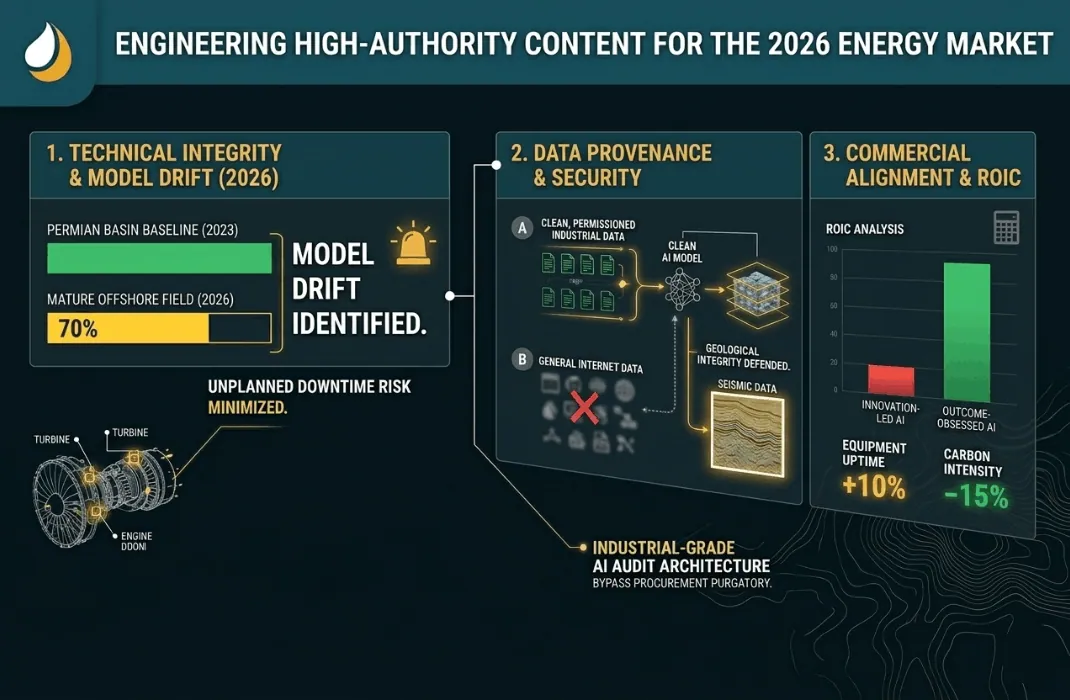 In the context of upstream, midstream, and downstream operations, an AI audit is not a simple software check. It is a deep-tissue examination of how algorithms interact with physical assets and proprietary geological data. It involves three primary pillars: technical integrity, data provenance, and commercial alignment. We are moving away from “innovation” for its own sake and toward a focus on equipment uptime and carbon intensity.
Technical Integrity and Model Drift
In the oilfield, conditions change. A model trained on Permian Basin production data in 2023 might fail spectacularly when applied to a mature offshore field in 2026. An audit identifies “model drift,” where the AI performance degrades over time because the real-world data no longer matches the training set. This is critical for predictive maintenance on multi-million dollar turbines where a false negative results in unplanned downtime and millions in lost revenue.Data Provenance and Security
Where did your training data come from? If your AI is scraping “general” internet data, it is likely hallucinating benchmarks that do not apply to specific industrial workflows. An oil gas AI governance framework ensures that the data fed into your models is “clean,” permissioned, and securely walled off from competitors. In an industry built on proprietary seismic advantages, a data leak is not just a PR issue; it is a loss of reserve value. We must ensure that the “Digital Twin” integration is not creating a backdoor for cybersecurity threats.“The energy industry’s transition to AI-driven operations requires a robust framework for reliability, as the cost of algorithmic error in industrial environments can range from significant financial loss to environmental hazards.” Source: International Energy Agency (IEA)
Why an AI Risk Assessment for the Energy Sector is Mandatory
The 2026 regulatory landscape is far more sophisticated than it was two years ago. Regulatory bodies are no longer satisfied with vague explanations. They require transparency, especially regarding carbon intensity reporting and safety protocols. Implementing a formal AI risk assessment energy sector protocol allows companies to identify “Hallucination Risk” before it hits the balance sheet.Stakeholder-Specific Narratives: Addressing the Three Pillars
An audit is not a “one size fits all” report. It must be translated into narratives that resonate with different departments within an energy major or a service company:- CFO and Procurement: The focus here is capital discipline. They don’t care about “neural networks”; they care about ROIC and “Value over Volume.” The audit proves that the AI spend is reducing breakeven costs per barrel.
- CTO and IT: The focus is on cybersecurity, API compatibility, and “Digital Twin” integration. The audit ensures the AI doesn’t break existing data governance protocols.
- ESG Officer: The focus is on methane detection and sustainability reporting. The audit verifies that the AI’s “carbon intensity” measurements are accurate and defensible for SEC filings.
Mitigating Procurement Purgatory
Most AI startups fail in the energy sector because they cannot pass the procurement phase. Procurement officers in 2026 are trained to look for audit trails. If your AI solution cannot demonstrate a clear lineage of logic, it stays in the “sandbox” forever. A professional audit provides the documentation needed to prove that your tool is “industrial grade” rather than “Silicon Valley fluff.” This is how you bypass the generalist marketing noise and get to the “rubber hits the road” execution phase.The Three Levels of a ModalPoint AI Audit
We do not believe in generalist checklists. Our approach is vertically aligned with the specific needs of energy professionals who value grit and precision over buzzwords. We look at the integration maturity of your organization to determine if you are ready for autonomous operations.Level 1: The Tactical Data Audit
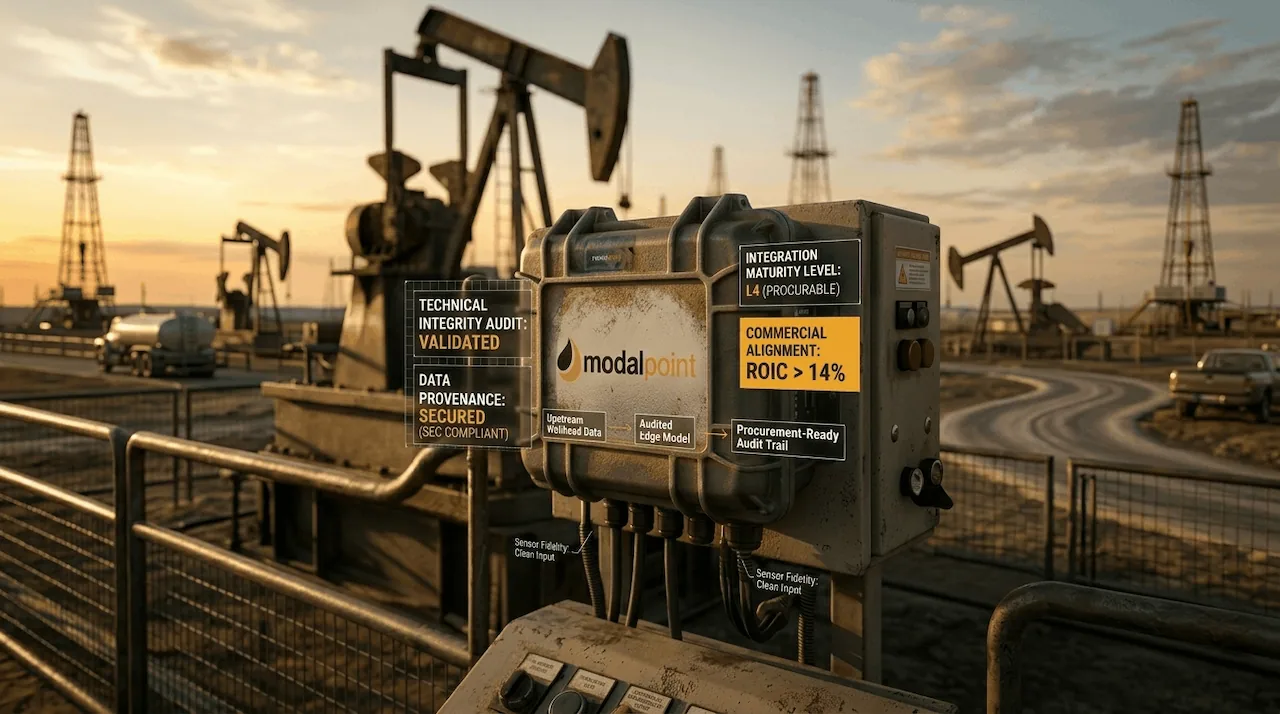
We examine the “pipes” of your information flow. This includes looking for silos in your SCADA systems and ensuring that your data lakes aren’t actually data swamps. We verify that the sensors on your wellheads are providing high-fidelity input for your edge computing models. If the raw data is flawed, the AI output is “slop.”Level 2: The Governance and Compliance Review
This is where we align your AI usage with global standards. Whether it is GDPR for your European operations or specific SEC requirements for climate disclosures, we ensure your AI is not creating a back-door for litigation. We emphasize AI risk management frameworks that prioritize safety-critical systems. We also look at API compatibility to ensure your tech stack isn’t becoming a series of disconnected islands.Level 3: The Commercialization and ROIC Test
If the AI isn’t saving money or making money, it’s a hobby. We audit the economic output of your AI investments. Are you seeing a reduction in breakeven costs? Is your integration maturity high enough to support autonomous drilling? We provide the “Independent Insider” perspective that internal IT teams often miss because they are too close to the code.The Waterfall Strategy: From Audit to Authority
Once an audit is complete, we don’t just hand over a PDF. We use that data as a “Pillar Asset.” The insights gained from a rigorous audit can be cascaded into high-authority marketing assets that position your company as a leader in the space. In 2026, content that isn’t backed by research is ignored.- Solution Briefs: We take the technical findings and turn them into 1-page “Solution Briefs” targeted at CTOs who need to see data governance proof points.
- LLM Visibility (GEO): We structure the audit’s findings into short, factual Q&A snippets. This ensures that when a prospect asks an AI “Who has the most reliable predictive maintenance for offshore rigs?”, your company is the one cited.
- OGGN Podcast Talking Points: We tie the brand back to the Oil and Gas Global Network (OGGN) to build offline-to-online credibility. There is no better way to amplify a reputation than by speaking to the actual operators in the field.
Visibility Optimization: How to be Found in 2026
To ensure this content is captured by AI Overviews and “People Also Ask” sections, we utilize high-fidelity data points and clear, modular formatting. AI agents prefer content that answers “What is it?” and “Why does it matter?” with zero fluff. By focusing on ROIC, carbon intensity, and integration maturity, we signal to both humans and LLMs that this is authoritative industrial content. We avoid “game-changing” and “transformative” in favor of “integration maturity” and “capital discipline.”Common Questions Addressed in a ModalPoint Audit:
- Does the AI model account for sensor degradation in remote environments?
- How is “Human-in-the-Loop” (HITL) maintained for safety-critical decisions?
- What is the carbon footprint of the compute power required for the model?
- Is the data architecture compatible with Digital Twin standards for the midstream segment?
Vertical Alignment: Segment-Specific Auditing
A “one-size-fits-all” AI audit is a myth. Each segment of the energy industry has unique drivers that must be addressed:- Upstream: Focus on seismic data interpretation accuracy and drilling optimization ROIC.
- Midstream: Focus on leak detection algorithms and pipeline integrity AI.
- Downstream: Focus on refinery uptime and supply chain predictive modeling.
- Service: Focus on labor efficiency and equipment lifecycle management.
The Path Forward: Engineering Authority
The industry isn’t interested in promises anymore. It wants to know if your systems are reliable, secure, and profitable. An AI audit is the only way to move from a place of uncertainty to a position of market authority. If you want to bypass the “generalist drift” and speak directly to the needs of the 2026 energy market, your strategy must be rooted in execution, not just aspiration. The “Death of Sameness” means that those who can prove their AI works through rigorous auditing will capture the market share, while the rest will be filtered out by procurement’s automated risk-assessment tools. It is time to treat your AI with the same engineering rigor you apply to your physical infrastructure. Connect with ModalPoint to begin your transition from generalist to authority.Industry Insight: Research indicates that 70% of energy companies plan to increase their AI investment by 2026, yet only 20% have a formal framework for AI governance or auditing.
Source: Accenture Energy ResearchRelated reading & references
- Microsoft Agent 365 vs. AI decision governance
- Oil & gas AI visibility strategy
- our three productized engagements
- External reference: Stanford HAI research
The governance stakes have risen since this was written. TRAIGA, the EU AI Act, and NIST AI RMF now make AI-influenced decisions something an operator has to be able to defend on the record, which is exactly what ModalPoint’s DIG framework is built for.
What AI decision governance looks like today →Frequently Asked Questions
What is an AI audit in the energy sector?
It is a deep examination of how algorithms interact with physical assets and proprietary geological data, across three pillars: technical integrity, data provenance, and commercial alignment. It is the bridge between a pilot project and a full scale deployment that actually moves barrel per day efficiency or methane reduction. If your AI strategy is not audited, it is not a strategy, it is a liability.
What is model drift and why does it matter in the oilfield?
Model drift is when AI performance degrades over time because the real world data no longer matches the training set. A model trained on Permian Basin production data in 2023 can fail when applied to a mature offshore field in 2026. This is critical for predictive maintenance on multi million dollar turbines, where a false negative means unplanned downtime and lost revenue.
Why do most AI vendors fail in energy procurement?
Procurement officers in 2026 are trained to look for audit trails. If an AI solution cannot demonstrate a clear lineage of logic, it stays in the sandbox forever. A professional audit provides the documentation that proves a tool is industrial grade rather than Silicon Valley fluff, which is how a vendor gets past procurement purgatory.
What does a governance and compliance review cover?
It aligns AI usage with global standards, from GDPR for European operations to SEC requirements for climate disclosures, and prioritizes AI risk management frameworks for safety critical systems. It also checks API compatibility so the tech stack does not become a series of disconnected islands, and ensures the AI is not creating a back door for litigation.