NIST AI RMF for Oil & Gas: A Practical Guide

By Matthew Bertram | EWR Digital
The energy sector is accelerating its deployment of automated algorithms, predictive maintenance models, and subsurface machine learning workflows. However, as capital-intensive operators integrate machine intelligence into operational technology and corporate decision-making, executive risk multiplies. When an algorithm miscalculates wellbore pressure, hallucinates vendor history, or misinterprets regulatory compliance data, the exposure extends far beyond IT departments. It becomes a board-level operational, legal, and financial liability.
To navigate these vulnerabilities, forward-thinking operators are turning to structured protocols. Applying the NIST AI framework oil gas operators rely on provides a structured path to ensure automated decision systems remain accurate, audit-ready, and fully governed across their lifecycle.
Understanding AI Risk Management Energy Leadership Must Control
Energy companies have managed physical, environmental, and financial hazards for decades using Health, Safety, and Environment (HSE) protocols and financial controls. Yet, artificial intelligence represents a novel category of risk. Unlike static software, machine learning algorithms adapt based on incoming training sets and external data inputs. If an external model ingests corrupted operational records or unverified third-party content, the output creates severe operational exposure.
Effective AI risk management energy frameworks ensure that automated systems are not treated as black boxes. Executives must verify how models derive conclusions, what sources feed their knowledge graphs, and who holds ultimate accountability for machine-generated outputs. Without proactive governance, energy firms face silent algorithmic drift, vendor contractual disputes, and unmonitored external brand misrepresentation in public AI search engines.
“Unlike traditional cybersecurity frameworks that focus primarily on protecting systems from external threats, the NIST AI Risk Management Framework takes a holistic view, evaluating technical vulnerabilities, transparency, and operational risks across the entire lifecycle.”
The Four Pillars of the NIST AI Risk Management Framework
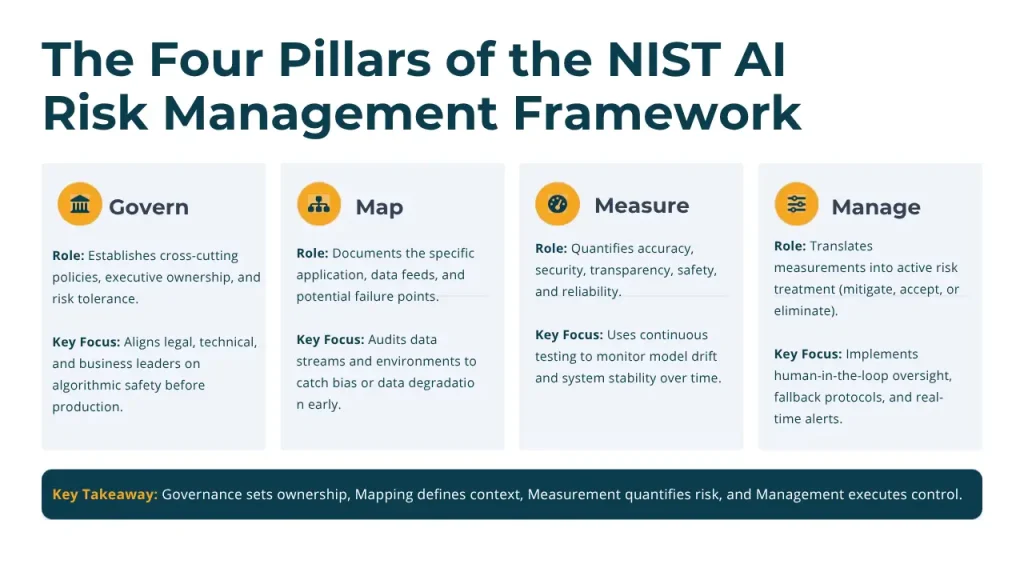
The National Institute of Standards and Technology established the AI Risk Management Framework (NIST AI RMF 1.0) to convert theoretical governance into repeatable enterprise controls. Designed to be voluntary yet foundational, the guidance published by NIST AI Guidance establishes four core functions that mirror traditional corporate governance structures.
1. Govern: Establishing Organizational Accountability
Governance is the cross-cutting foundation that powers all other risk functions. It defines who owns machine learning liability within the executive suite. In oil and gas operations, governance establishes clear policies regarding data ownership, regulatory disclosures, and risk tolerances. It ensures that the General Counsel, Chief Technology Officer, and business unit leaders share a unified standard for evaluating algorithmic safety before tools enter production environments.
2. Map: Contextualizing Risks and Data Inputs
The Map function requires organizations to document the specific operational context of every deployed AI asset. Operators must map the intended application, identify potential failure modes, and evaluate the underlying data streams. For instance, mapping a predictive pipeline monitoring algorithm involves auditing sensor data feeds, historical maintenance records, and external environmental inputs to identify where algorithmic bias or data degradation could produce false negatives.
3. Measure: Quantifying Trustworthiness and Accuracy
You cannot govern what you do not measure. The Measure function evaluates algorithms against seven core characteristics of trustworthy technology: validity, reliability, safety, security, transparency, explainability, and privacy. Energy enterprises utilize rigorous quantitative testing and qualitative peer reviews to continuously analyze model drift, system stability, and information integrity over time.
4. Manage: Allocating Resources to Mitigate Exposure
The Manage function turns analytical measurement into concrete action. Once risks are identified and measured, executive teams determine whether to treat, transfer, accept, or eliminate specific algorithmic threats. Manage protocol mandates establishing human-in-the-loop oversight, fallback operational procedures, and real-time response mechanisms when automated tools operate outside predetermined parameters.
Bridging Technical Operations and Oil Gas AI Compliance
Achieving comprehensive oil gas AI compliance requires bridging the gap between field-level data execution and executive legal defense. Regulatory bodies and statutory standards such as the Texas Regulatory Artificial Intelligence Governance Act (TRAIGA) are raising the baseline for corporate transparency. Organizations must demonstrate that their internal algorithms and external digital footprints are accurate, defensible, and fully documented.
Managing the External AI Representation Layer
While internal model validation protects operations, energy leaders often overlook how public AI search engines summarize their commercial capabilities. Search tools like ChatGPT, Perplexity, and Google AI Overviews scrape public websites, trade publications, and third-party databases to generate real-time briefings for investors, partners, and regulators. If public information about your firm’s ESG performance, technical capabilities, or executive leadership is unstructured or inaccurate, AI engines repeat hallucinated claims that harm corporate valuation.
Implementing Digital Information Governance
Digital Information Governance® (DIG) provides the operational framework necessary to align internal compliance with external AI discovery. By structuring corporate data, securing entity authority, and auditing information pipelines, operators ensure that both internal automated systems and external commercial models ingest grounded, accurate data. DIG transforms raw digital presence into a governed corporate asset that resists competitive displacement and regulatory scrutiny.
A Practical Roadmap for Energy Executives
Implementing the NIST framework does not require replacing existing systems or launching multi-year consulting engagements. Leaders can establish an effective governance foundation through a structured three-step execution roadmap:
- Audit Existing Capabilities: Execute an immediate inventory of all active algorithms, automated workflows, and external AI descriptions to uncover hidden data liabilities.
- Assign Clear Governance Ownership: Eliminate internal silos by linking Marketing visibility, Legal risk management, and IT infrastructure under a unified governance charter.
- Formulate Remediation Roadmaps: Establish documented response protocols and structured data architectures to correct hallucinations, enforce transparency, and fulfill regulatory compliance requirements.
By treating machine governance as a core business discipline rather than an IT task, energy executives protect operational profitability while establishing market authority. Partnering with specialized advisors like ModalPoint allows enterprise leadership to audit, govern, and defend their AI presence across every operational and public domain.
Key Energy AI Governance Metric
According to industry research from Schneider Electric, implementing structured AI governance frameworks across energy and industrial operations has been shown to reduce regulatory compliance penalties by up to 50% while drastically improving automated operational risk forecasting. Source: Schneider Electric Energy Risk Report.