Oil & Gas AI Visibility: Schema, Entities, & E-E-A-T
By Matthew Bertram | EWR Digital
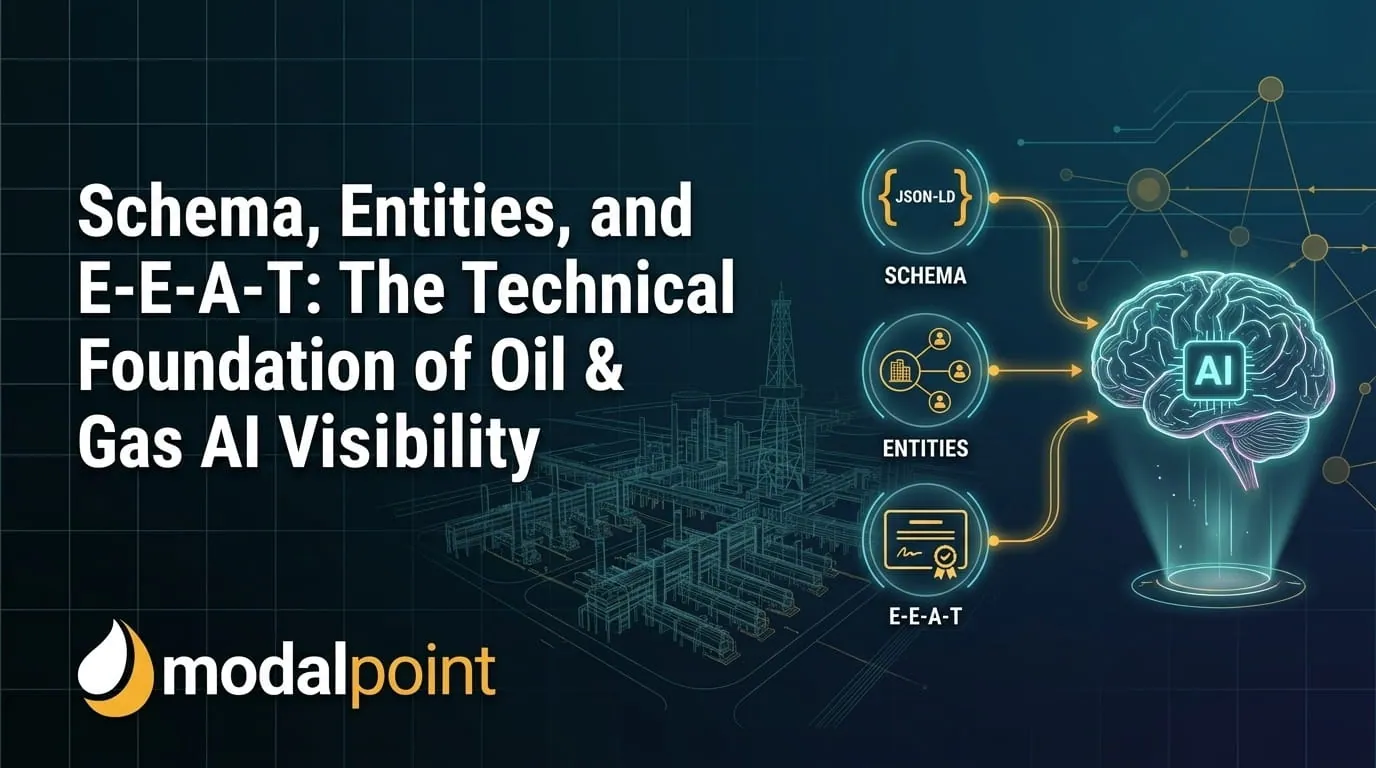
Your enterprise digital footprint is no longer evaluated primarily by human procurement managers or traditional web searchers. Today, LLMs such as ChatGPT, Perplexity, Gemini, and Google AI Overviews read, synthesize, and report on your organization before a potential client ever visits your website. If your enterprise lacks a structured digital footprint, AI platforms draw inferences from outdated press releases, third-party aggregators, or competitor marketing materials. To govern how machine engines describe your company, energy organizations must establish an authoritative technical foundation anchored in robust entity architecture, structured markup, and verifiable trust signals.
Establishing control over how autonomous systems evaluate upstream, midstream, and downstream entities requires implementing formal digital information governance. Without direct governance over published corporate data, AI engines fill knowledge gaps with unverified assumptions, exposing your enterprise to commercial displacement and compliance liabilities.
Understanding Entity SEO Energy Sector Frameworks in Modern AI Discovery
Traditional search engines matched typed search queries to specific keywords across static web pages. Modern Answer Engines operate differently: they map relationships between real-world concepts, organizations, assets, and executive leaders within a unified Knowledge Graph. This structural shift makes entity SEO energy sector strategy the bedrock of organizational discoverability.
An entity is a distinct concept that an AI model can uniquely identify without ambiguity. In the energy sector, entities include operator names, shale basins, refining facilities, proprietary oilfield technologies, regulatory filings, and key executives. When an AI engine answers high-intent commercial queries, it queries its internal knowledge graph to verify whether an enterprise possesses genuine operational authority in that domain.
The Architecture of Entity Recognition in Energy Markets
When autonomous engines process enterprise data, they parse information into subject-predicate-object triples. For example, the statement “ModalPoint provides AI representation risk audits for energy firms” establishes a verified relationship between an organization and a capability. If your digital assets lack clear relationship definitions, AI platforms suffer from entity confusion. In high-stakes vendor evaluations, an oilfield services provider might be miscategorized as a generic labor staffing firm, effectively removing them from consideration.
To eliminate entity ambiguity, energy enterprises must actively build and govern their entity profiles across internal web properties and external authoritative directories. Establishing a canonical identity ensures that every machine query accurately attributes technological capabilities, executive expertise, and geographic reach to the correct legal entity.
Implementing Custom Schema Markup Oil & Gas Protocols for LLM Ingestion
Schema markup is machine-readable code, formatted in JSON-LD, that explicitly instructs search engines and artificial intelligence models about the exact nature of your content. Implementing structured schema markup oil & gas standards provides LLMs with unambiguous data parameters, converting unstructured web text into structured enterprise intelligence.
While generic corporate websites rely on basic schema tags, energy companies require deeply customized nested schemas to reflect their complex operational environments, technical intellectual property, and regional asset distribution.
Key Schema Types for Heavy Industry and Energy Operators
To ensure total clarity across AI indexing pipelines, energy firms must implement specific JSON-LD structures:
- Organization and Corporation Schema: Defines primary company identity, parent-subsidiary hierarchies, legal enterprise names, stock symbols, and official executive leadership profiles.
- Service and Product Schema: Clearly itemizes specialized technical capabilities, offshore equipment specifications, or proprietary software tools, ensuring AI systems do not misclassify core offerings.
- About and Mentions Schema: Explicitly connects corporate content to recognized industry entities, such as specific shale basins, regulatory bodies, or operational compliance standards.
- FAQ Page Schema: Engineers direct, factual Q&A blocks designed specifically for Answer Engine Optimization (AEO) and AI Overview retrieval.
By embedding structured schema across your web assets, you remove speculation from machine ingestion. AI systems parse structured data directly into their context windows, ensuring your enterprise is cited with factual precision during buyer research cycles.
Building E-E-A-T Oil & Gas AI Visibility Across Regulated Markets
Search engines and AI models evaluate source authority using the E-E-A-T framework: Experience, Expertise, Authoritativeness, and Trustworthiness. In capital-intensive and heavily regulated sectors, establishing E-E-A-T oil & gas AI visibility is not merely an SEO exercise; it is an essential corporate risk mitigation requirement.
AI models prioritize information sourced from demonstrated subject matter experts. When an LLM generates summaries regarding offshore safety protocols, pipeline integrity management, or subsurface data analytics, it selectively extracts content from sources that demonstrate verifiable domain authority.
As industry analysts emphasize, aligning enterprise data architecture with governance standards is essential for achieving operational return on AI investments.
“Nearly everything today, from the way we work to how we make decisions, is directly or indirectly influenced by AI. But it doesn’t deliver value on its own. AI needs to be tightly aligned with data, analytics and governance to enable intelligent, adaptive decisions and actions across the organization.”
Carlie Idoine, VP Analyst at Gartner (Gartner Data & Analytics Research)
Operationalizing the Four Pillars of E-E-A-T in Energy Content
To secure top-tier citation rights in AI-assisted discovery, enterprise content strategy must integrate formal E-E-A-T controls across published assets:
- Verifiable Subject Matter Expertise: Anchor strategic insights to recognized corporate leaders. Detailed analysis of energy sector organizational structure demonstrates operational depth to LLMs scanning for industry authority.
- Technical First-Party Data: Publish original field case studies, proprietary operational metrics, and documented engineering benchmarks. AI engines prioritize unique data points over generic summary copy.
- Defensible Source Attribution: Ensure operational, regulatory, and environmental claims are backed by official documentation or recognized technical standards, preventing AI hallucination during content synthesis.
- Entity Consistency Across Web Assets: Maintain uniform enterprise details across news publications, SEC filings, trade association registers, and official company portals to reinforce foundational trust metrics.
Overcoming Entity Confusion and Misattribution in AI Search
When AI models encounter unstructured or conflicting data across web sources, they frequently experience entity confusion. In the energy sector, this manifests when an LLM attributes one firm’s technological innovation to a competitor, repeats outdated M&A details, or cites obsolete HSE certifications.
Entity confusion introduces severe commercial risk. Prospective clients querying AI assistants for technical partners may receive recommendations that misstate your firm’s operational capacity or falsely claim non-compliance. Resolving entity confusion requires systematically auditing external data sources, rectifying schema discrepancies, and establishing a single, immutable source of truth across your digital ecosystem.
Governing the AI-Facing Layer with Digital Information Governance
Managing how artificial intelligence interprets your enterprise requires moving beyond legacy SEO tactics. It demands an executive-level Digital Information Governance framework that unifies marketing visibility with legal risk management and technical data architecture.
Without centralized oversight, unverified statements, unanchored brand metrics, and ambiguous entity markup propagate across machine learning datasets unchecked. By auditing and governing your digital footprint, your leadership team ensures that autonomous systems discover, interpret, and present your organization accurately and defensibly.
Industry Governance Benchmark:
According to global research from the Gartner D&A Summit, by 2027, 60% of organizations will fail to realize the anticipated value from their AI investments due to incohesive governance frameworks. Furthermore, knowledge graphs are projected to be leveraged by over 40% of LLMs to provide the semantic context essential for accurate AI retrieval.
To audit your current digital footprint and secure your organization’s AI representation layer, consult with the strategy team at ModalPoint.