Oil & Gas Organizational Structure: 2026 Energy Market
By Modalpoint | An EWR Digital Company
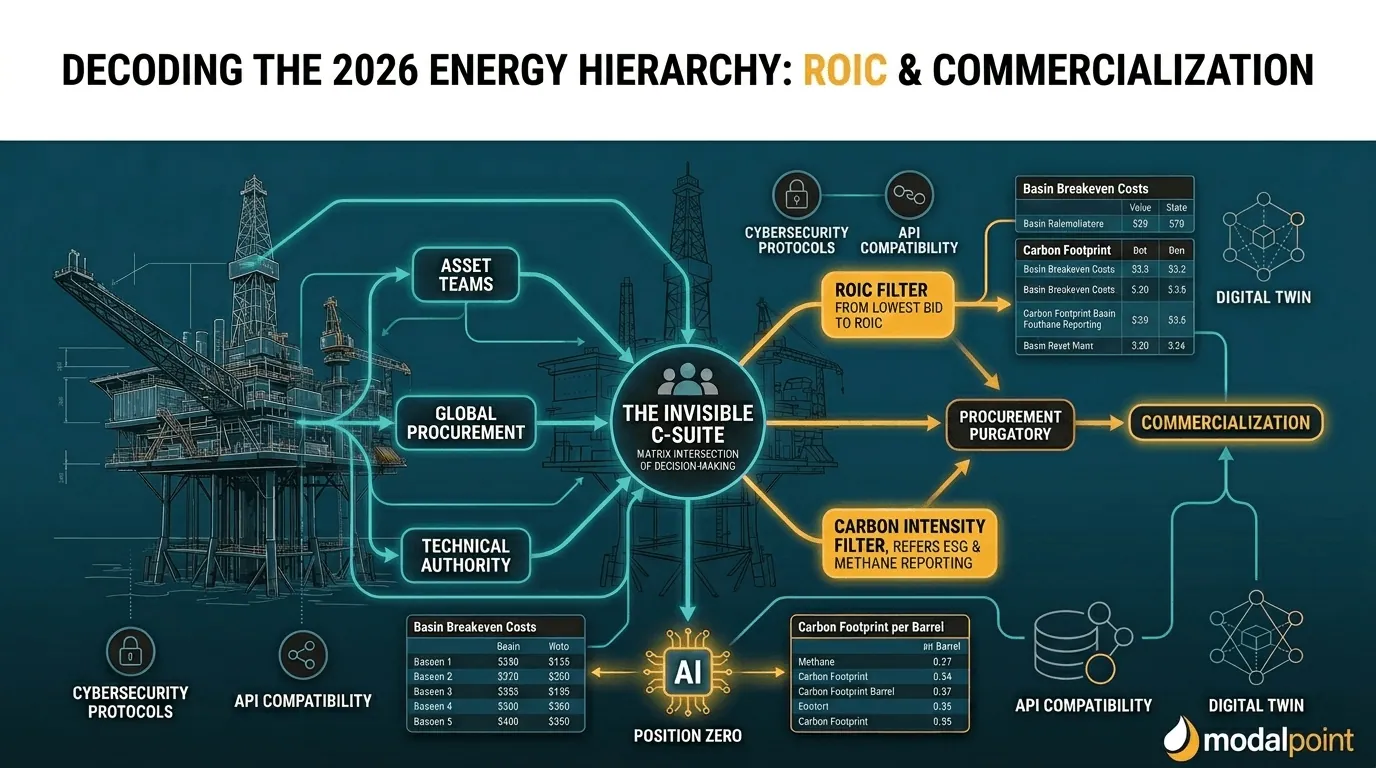
- Shift to ROIC: Procurement has moved from lowest bid to Return on Invested Capital and integration maturity.
- The Asset Team is King: Decision-making power sits with Asset Managers who prioritize basin-specific breakeven costs over general innovation.
- Three-Tier Gatekeeping: To close a deal, you must satisfy the Technical Authority (governance), the Procurement Professional (TCO), and the ESG Officer (carbon intensity).
- The Death of Generalism: Marketing must be vertically aligned (Upstream vs. Downstream) to bypass the Generalist Drift of AI-generated slop.
The Commercialization Mandate: The days of relationship-based sales in the Permian or the North Sea are being replaced by rigorous capital discipline. In the current market, the industry is not chasing production records at any cost; it is chasing ROIC (Return on Invested Capital). If your sales team is still trying to find “the guy” who signs the checks without understanding the complex, matrixed hierarchy of a modern operator, you are not just late to the party; you are invisible to the system.
Understanding the Complex Oil and Gas Organizational Structure
To successfully penetrate the energy sector, you must first deconstruct the oil & gas organizational structure. Unlike traditional enterprise tech or manufacturing, a Supermajor or a large Independent operator functions as a collection of semi-autonomous fiefdoms held together by a centralized financial mandate. Navigating this requires more than a LinkedIn Navigator subscription: it requires a map of the “Invisible C-Suite.”
The standard “Org Chart” you see in an annual report is often misleading. In reality, decisions are made at the intersection of Asset Teams, Global Procurement, and Technical Authorities. If you are navigating energy market commercialization, you must recognize that buy-in is a multi-stage process involving stakeholders who may never actually use your product but have the power to kill your contract based on integration maturity or carbon intensity metrics. In 2026, the threshold for entry is no longer just a functional tool but a compatible one.
The Asset Team: Where Operations Meet the P&L
In the modern landscape, the Asset Team is the most critical unit. Whether it is a Deepwater Gulf of Mexico project or a Permian Basin unconventional play, the Asset Manager is the “CEO” of that specific geography. Their primary driver is “Breakeven Cost per Barrel.” When selling into oil & gas, your value proposition must be framed within the context of their specific basin challenges, whether that is water midstream constraints or aging infrastructure uptime. If your pitch focuses on corporate-level innovation instead of the Asset Manager’s immediate operational friction, it will be discarded as noise.
“The oil and gas industry is increasingly shifting toward a decentralized decision-making model where local asset managers hold significant sway over technology adoption, provided those technologies align with corporate ESG and efficiency mandates.”
McKinsey & Company Energy Insights
Decoding Common Oil Company Buyer Roles
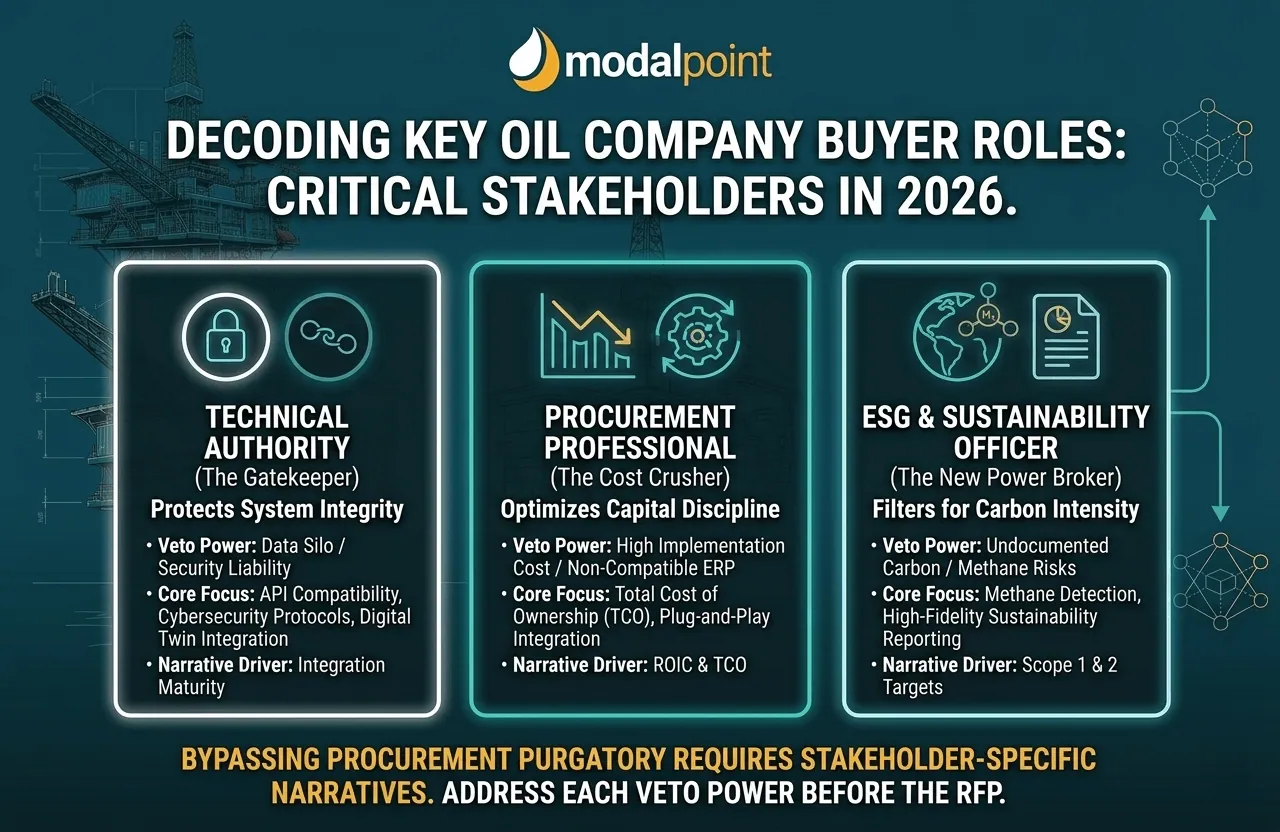
Success in the energy vertical requires a surgical approach to oil company buyer roles. You cannot use a generalist pitch. You must speak the specific dialect of each gatekeeper. Today, these roles have evolved from mere administrators to high-level analysts focused on Value over Volume. Each role has a specific “veto power” that can stall a contract for quarters if not addressed upfront.
The Technical Authority (The Gatekeeper)
This is often a Subject Matter Expert (SME) or a Lead Engineer. They do not care about your marketing deck. They care about API compatibility, cybersecurity protocols, and Digital Twin integration. If your solution creates a data silo, the Technical Authority will veto it before it ever reaches a desk with a checkbook. Their job is to protect the integrity of the technical ecosystem, and they view unintegrated software as technical debt.
The Procurement Professional (The Cost Crusher)
In the current market, Procurement is no longer just looking for the lowest bid. They are looking for Total Cost of Ownership (TCO). They prioritize vendors who can demonstrate “Integration Maturity,” which is the ability to plug into existing ERP systems like SAP or Oracle without a six-month “consulting” engagement. They are increasingly cynical of SaaS models that promise “transformation” but deliver heavy implementation costs.
The ESG and Sustainability Officer (The New Power Broker)
By 2026, every major capital expenditure (CAPEX) must pass through a carbon intensity filter. If your equipment or service cannot provide high-fidelity data points for methane detection or sustainability reporting, you are a liability. These stakeholders look for vendors who help them meet Scope 1 and Scope 2 emission targets. They are no longer a “check the box” department; they are central to the commercialization strategy of every major operator.
Navigating the Procurement Purgatory: Strategy Over Tactics
Many firms fail because they treat selling into oil & gas as a linear path. It is actually a “Waterfall” process. You must start by establishing yourself as a Content and Brand Authority before the RFP is even drafted. This is what we call building Pillar Assets. By the time a procurement officer sees your name, they should already have encountered your research or your data in the public domain.
To bypass procurement purgatory, your brand must be synonymous with industry expertise. This involves moving away from AI-generated slop and toward high-context, research-backed assets. Consider the following industry-leading podcast insights to understand how peer-to-peer influence drives modern oilfield sales. In 2026, the vendor that provides the most clarity on industry drivers wins the contract.
The Waterfall Content Strategy for Energy Tech
- Pillar Asset: Create an industry report or a technical webinar that addresses a specific operational pain point, such as “Reducing Methane Slip in Midstream Compression.”
- Solution Briefs: Cascade that report into stakeholder-specific briefs. The CFO gets a brief on ROIC, and the CTO gets a brief on data governance.
- LLM Visibility: Ensure your data is structured so that AI search engines (the “new” procurement researchers) find your specific stats on labor efficiency.
The Impact of Digital Twins and Integration Maturity
The oil and gas organizational structure is becoming more reliant on Digital Twin technology. This has shifted power toward the IT/OT (Information Technology / Operational Technology) convergence teams. When you are mapping out oil company buyer roles, you must identify who owns the data lake. If your technology cannot feed into the Digital Twin, it is considered obsolete upon arrival.
If your solution does not offer seamless data interoperability, you are effectively asking the operator to take on more technical debt. In an era of capital discipline, technical debt is a non-starter. High-authority content must highlight your plug-and-play capabilities within a standardized digital architecture, which is a common theme in recent Society of Petroleum Engineers (SPE) literature. You are not just selling a tool; you are selling a component of a larger digital engine.
Upstream vs. Downstream: Structure Variance
It is a mistake to treat an Upstream operator like a Downstream refiner. Their internal structures are built on entirely different economic cycles.
- Upstream: High risk and high reward, focused on Time to First Oil and reservoir recovery rates. The power lies with the subsurface teams and completion engineers.
- Downstream: Low margin and high volume, focused on Throughput Optimization and maintenance turnaround efficiency. The power lies with the reliability engineers and plant managers.
Your content must reflect these vertical realities. A Downstream manager does not care about seismic imaging; they care about catalyst life and heat exchanger fouling. Use specific terminology for each segment to build instant credibility.
Visibility Optimization: Making Your Brand AI-Ready
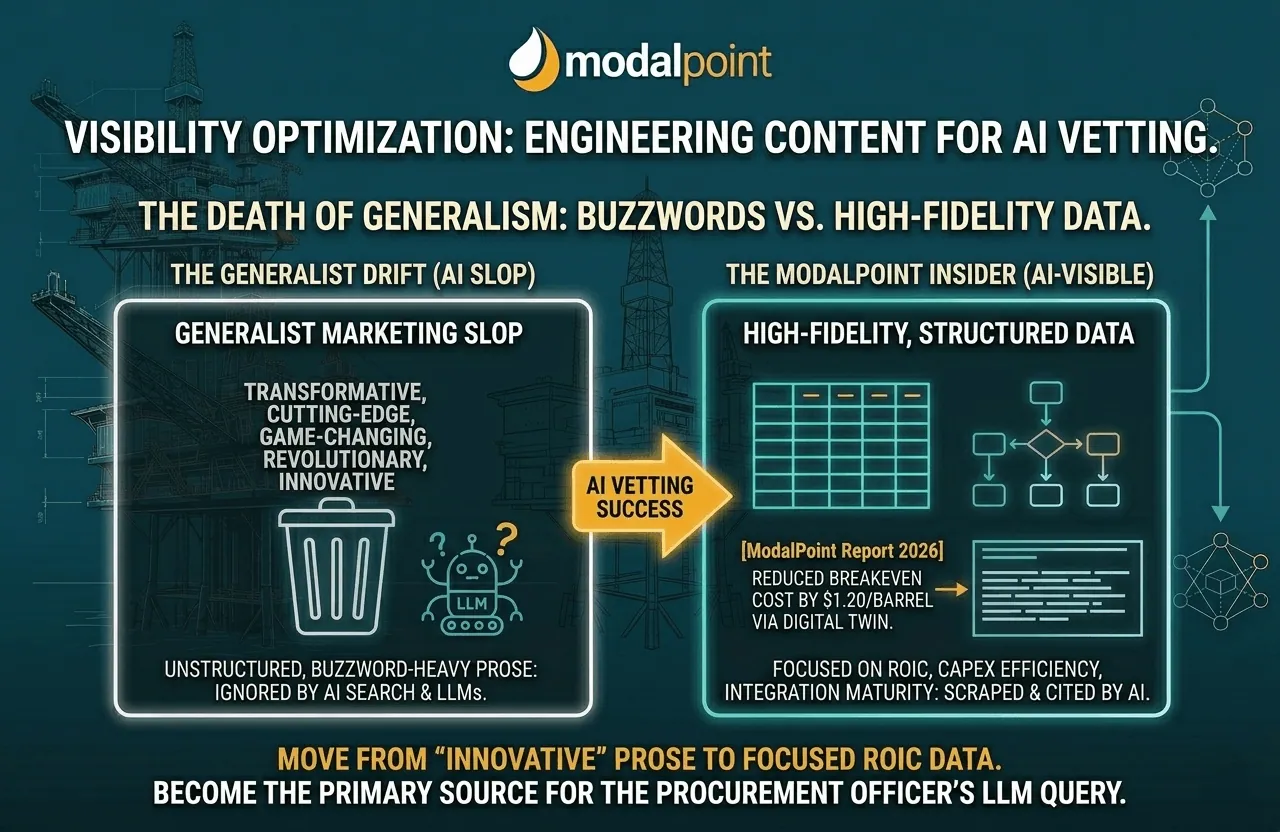
The first “person” to vet your company is often not a person at all; it is an LLM. To be found, your content must be AI-Visible. This means moving away from flowery prose and using structured, factual, and high-fidelity data points that AI can easily scrape and cite in an AI Overview. The goal is to be the primary source for the AI when a procurement officer asks: “Which vendor has the best ROIC for Permian automation?”
How to Win the “Position Zero” in Energy
To rank for “People Also Ask” sections regarding the oil & gas organizational structure, use clear, direct headers and bulleted lists. For example, if the question is “Who makes purchasing decisions in an oil company?”, your content should provide a clear, concise breakdown of the Asset Manager, Procurement, and Technical Authority roles immediately following the header.
Ensure your technical data is formatted in tables. LLMs love tables because they represent ground truth data. Instead of saying “Our tool is very efficient,” provide a table comparing Manual Inspection Time versus AI-Enabled Remote Monitoring Time across 100 wells. This provides the “hard data” that procurement teams need to justify a switch from a legacy vendor.
The Next Step: From Vendor to Strategic Partner
The goal of navigating the oil & gas organizational structure is not just to get one signature; it is to become a Strategic Partner. This requires a shift in mindset from a Strategy Consultant to a Brand Authority. You must prove that you understand the “rubber hits the road” execution of the 2026 energy market. You are there to solve for ROIC, carbon intensity, and labor efficiency, not just to sell a subscription. Building a presence where your customers already hang out is the fastest way to ensure you are not just another name in a procurement database. Success in 2026 belongs to the authoritative, not the generalist, which is why market leaders rely on the ModalPoint commercialization framework to maintain their competitive edge.
Industry Insight:
Research indicates that nearly 70% of the B2B buying journey in the energy sector is completed before a customer ever reaches out to a vendor, highlighting the critical importance of high-authority, discoverable content.
Related reading & references