2026 Oil & Gas Content Playbook: B2B AI Visibility Strategy
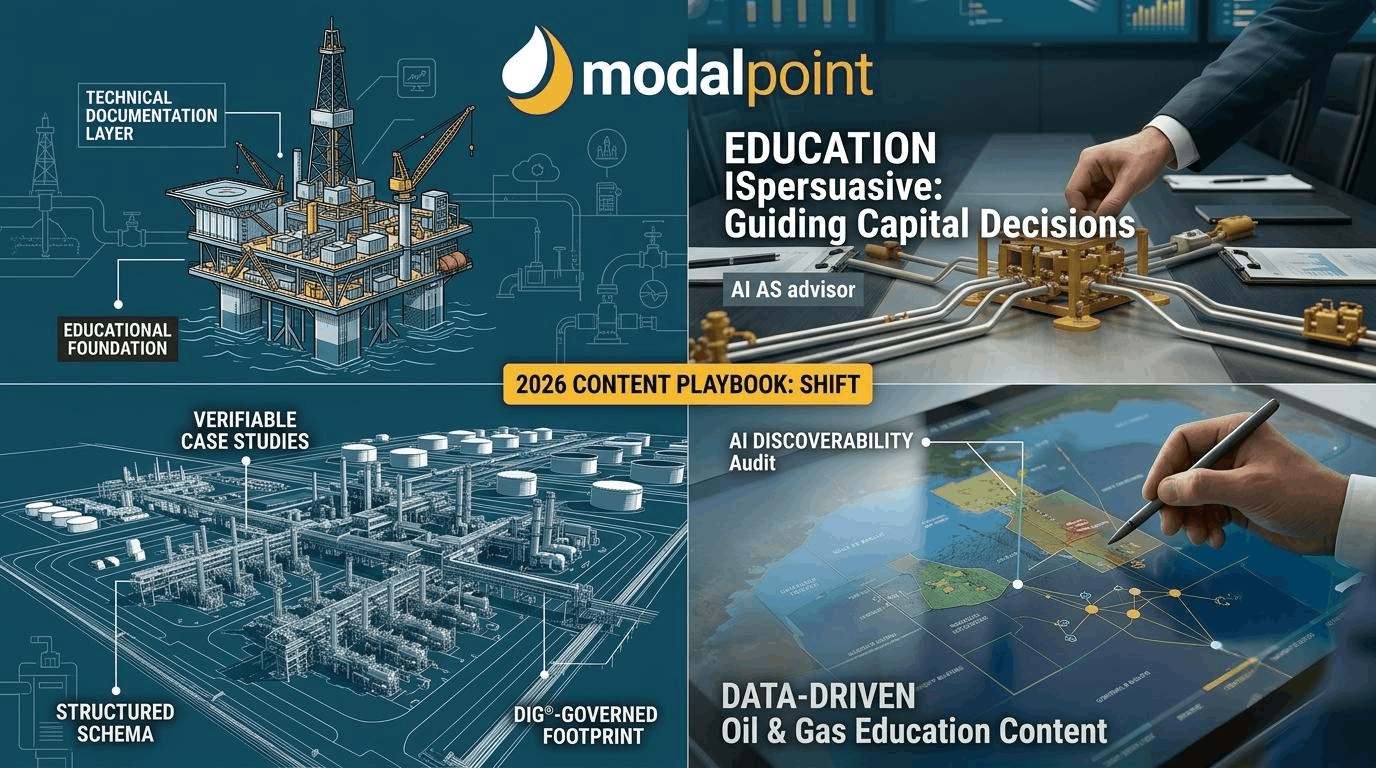
By Matthew Bertram | EWR Digital
The traditional B2B sales cycle in the energy sector is dead. For decades, oilfield services providers and energy tech firms relied on trade shows, golf tournaments, and handshakes to secure multi-million-dollar contracts. But in 2026, a structural shift has quieted those golf courses: the modern energy buyer is no longer waiting for your pitch. Instead, they are asking artificial intelligence engines to analyze your company’s operational capability before your business development representative even gets a foot in the door.
According to research from Forrester, a staggering 89% of B2B buyers now use generative AI tools at every stage of the purchasing process . When a Chief Operating Officer or VP of Supply Chain needs to solve an operational bottleneck, they do not search Google for “best slickline operator in the Permian.” They command an LLM to “evaluate oilfield services companies with proven decarbonization protocols and zero non-productive time (NPT) in high-pressure, high-temperature environments.” If your digital footprint lacks structured, educational, and technically accurate documentation, your organization is commercially invisible to the machines that now guide buying decisions.
This is why high-performing operators are shifting away from generic promotional fluff. To protect your market share, you must master oil & gas content marketing, transforming your corporate digital footprint from a passive brochure into an educational data engine that feeds hungry AI algorithms.
Shifting from Promotion to Oilfield Services Education Content
In capital-intensive, highly regulated environments, promotional content like “we are the leading innovator” is worse than useless. It is a commercial liability. Generative AI engines do not rely on self-proclaimed marketing superlatives. They scrape technical documentation, structured schema, white papers, and regulatory filings to construct an entity profile of your business. If your website is filled with empty sales pitches, AI will flag your brand as a low-authority entity.
To win inside modern search and AI engines, your energy sector content strategy must prioritize educational depth over marketing volume. Your target audience consists of engineers, compliance officers, and operations managers. They do not buy products; they buy risk mitigation.
“As Salesforce reports, nearly 90% of buyers want salespeople to act as experts or advisors who guide them in their purchasing decisions. This is especially true in the renewables industry, where consumers are often buying large-ticket items with long-term commitments in an unfamiliar technological setting. Education can be more persuasive than advertising, and the marketing department can support these aims by producing content that enables everyone in the organization to speak confidently.”
By focusing heavily on highly technical oilfield services education content, you satisfy both human decision-makers and AI aggregators. When you publish precise case studies detailing how your chemistry reduced fluid-loss in the Bakken, you provide the exact semantic proof points that modern Search Generative Experiences (SGE) and AI Overviews require to cite your company as a trusted solution.
Engineered for AI: The Technical Reality of 2026 Energy Sector Content Strategy
To successfully govern how AI represents your organization, you must build a defensible information architecture. AI engines do not read your website the way a human does; they ingest it as training material. If your entity relations are unclear, the AI will default to “entity confusion,” potentially recommending a competitor or repeating outdated commercial statistics.
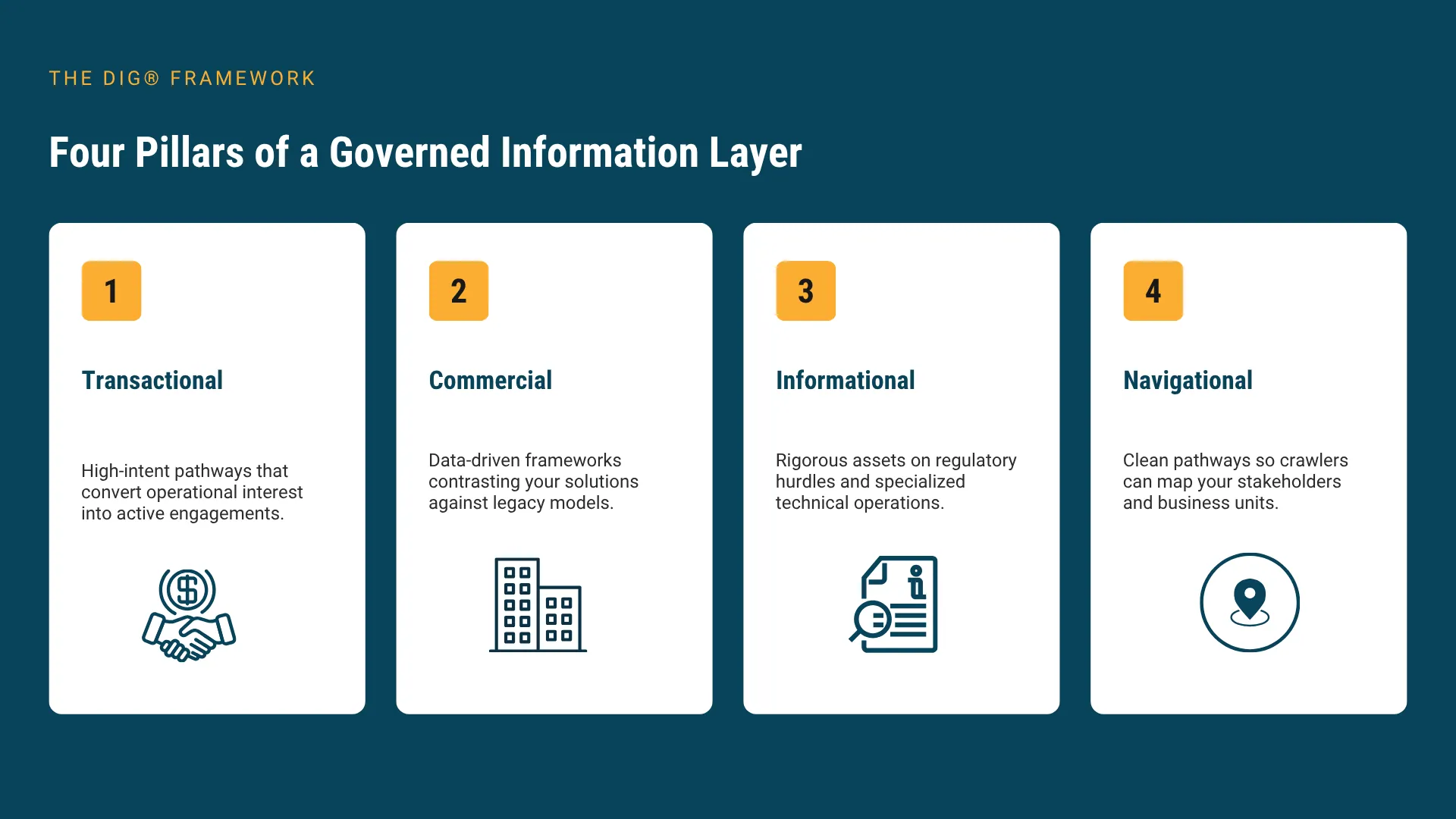
Our advisory work at ModalPoint has formalized this framework under the discipline of Digital Information Governance® (DIG). This framework requires oil and gas companies to balance their information layer across four primary areas to satisfy modern search engines and AI scrapers alike:
- Transactional Content: High-intent, risk-mitigation pathways that convert qualified operational interest into active engagements, such as requesting an AI Visibility Audit.
- Commercial Content: Data-driven frameworks that contrast your technological solutions against legacy oilfield service models without relying on unsupported claims.
- Informational Content: Rigorous, educational assets addressing regulatory hurdles, supply chain bottlenecks, and specialized technical operations.
- Navigational Content: Clean, structured pathways ensuring search crawlers and AI crawlers can map your key corporate stakeholders and business units instantly.
When these four spaces are aligned, AI engines can easily discover and accurately represent your capabilities. If they are neglected, you expose your organization to profound AI representation risk: a silent, commercial vulnerability where LLMs describe your business inaccurately, ignore your primary solutions, or exclude you from consideration altogether.
Factual Scannability: Optimizing for Position Zero and AI Overviews
To secure a spot in Google’s “Featured Snippets” or “People Also Ask” blocks, your digital assets must be structured logically. Use clear HTML headings, answer technical questions directly within the first two sentences of a section, and present complex data tables that allow machine-learning algorithms to parse and extract your information easily. When your content is structured logically, you win the battle for discoverability.
Frequently Asked Questions Regarding Energy Sector Discoverability
How does Digital Information Governance® (DIG) protect oil and gas brands?
DIG establishes a structured, audited, and defensible digital footprint that AI engines can easily parse. By governing your external information layer, you prevent AI hallucination, neutralize competitor hijacking inside LLM search tools, and ensure that only accurate, authorized technical claims are repeated by generative models.
Why is educational content more effective than promotional content in B2B energy marketing?
B2B energy purchases are defined by high capital risk and strict compliance frameworks. Educational content builds brand authority by providing the verifiable data, technical specs, and case studies that engineers and procurement teams require to make informed decisions, while simultaneously serving as clean training data for AI recommendation engines.
What is AI representation risk in the oilfield services sector?
AI representation risk is the commercial and legal exposure created when AI models (like ChatGPT or Google Gemini) misrepresent a company’s capabilities, cite outdated safety metrics, or display entity confusion that redirects high-value enterprise buyers to market competitors.
Industry Authority Data
According to B2B marketing research compiled by the Content Marketing Institute, 61% of technical content marketers state that creating the exact right content that resonates with their highly specialized audience remains their single greatest operational challenge .
The Next Step: Governing Your Digital Footprint
If you do not actively govern your digital presence, AI platforms will define your business for you. Your website is no longer just a marketing channel; it is training material for machines that are currently describing your organization to your prospects without your explicit consent.
Before you invest another dollar into generic digital transformation campaigns, you must diagnose your exposure. Partner with ModalPoint today to secure your digital footprint:
- AI Visibility Audit: Discover exactly how ChatGPT, Perplexity, Gemini, and Google AI Overviews interpret, cite, and recommend your organization right now.
- DIG Audit: Get a complete Digital Information Governance roadmap to align your technical assets, correct entity confusion, and protect your commercial visibility.