Oil & Gas Go-to-Market Checklist: 12 Critical Steps
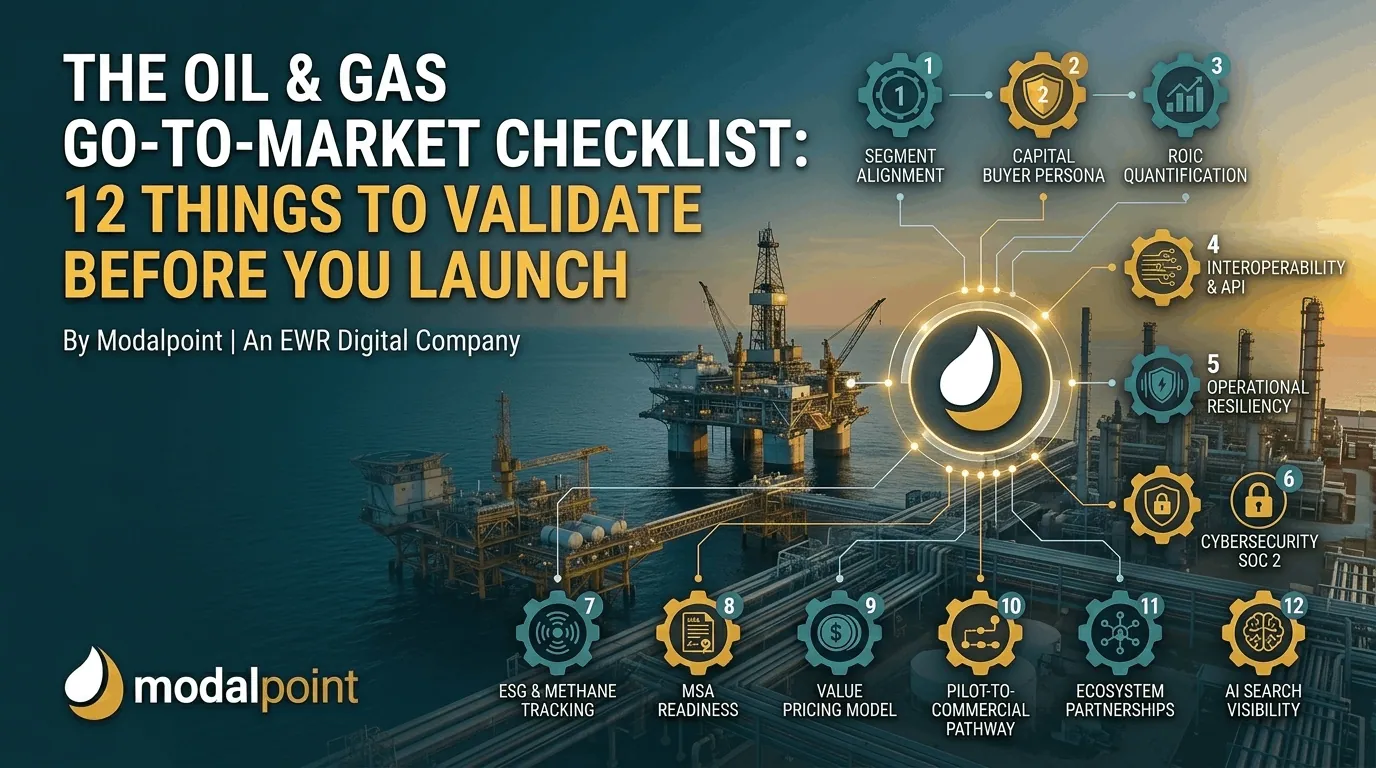
By Modalpoint | An EWR Digital Company
The energy landscape has shifted permanently away from production volume and toward strict financial discipline. Navigating this environment requires moving past generalist marketing concepts and focusing on the rigid realities of oilfield operations. Whether you are scaling an automated drilling solution or launching an advanced edge analytics tool, your commercialization framework must match the exact operational and financial metrics used by modern operators.
Why Traditional Energy Sector Market Entry Strategy Fails
Most field technology providers fail because they sell features instead of financial outcomes. To protect capital allocation and ensure sustainable growth, you need an enterprise-grade framework that addresses technical integration, procurement gatekeepers, and field deployment realities simultaneously. Utilizing a comprehensive oil & gas go-to-market checklist ensures your product is positioned as a critical operational asset rather than an unverified line-item expense.
When engineering your approach for a high-stakes oilfield services launch, you cannot rely on conventional enterprise software marketing. The market demands proven integration maturity and immediately quantifiable capital efficiency. If your field solution cannot show a direct pathway to reducing lease operating expenses or expanding equipment uptime within the first quarter of deployment, your business development efforts will stall indefinitely.
To successfully navigate an energy sector market entry, technology providers must balance technical performance with the strategic priorities of the executive suite. The modern industrial buyer is deeply cynical of generalist marketing claims. The following twelve validation checkpoints provide the exact framework needed to verify commercial readiness, satisfy procurement requirements, and command immediate authority across the industrial supply chain.
“Synchronize capital discipline with tech-forward integration. Balance rigorous capital allocation with purposeful investments in gen AI, advanced analytics, digital enablement, and tech-based alliances to ensure that caution does not limit opportunity and digital adoption is implemented only where it delivers clear value.”
The 12-Point Commercialization Framework for Heavy Industry
1. Clear Segment and Vertical Alignment
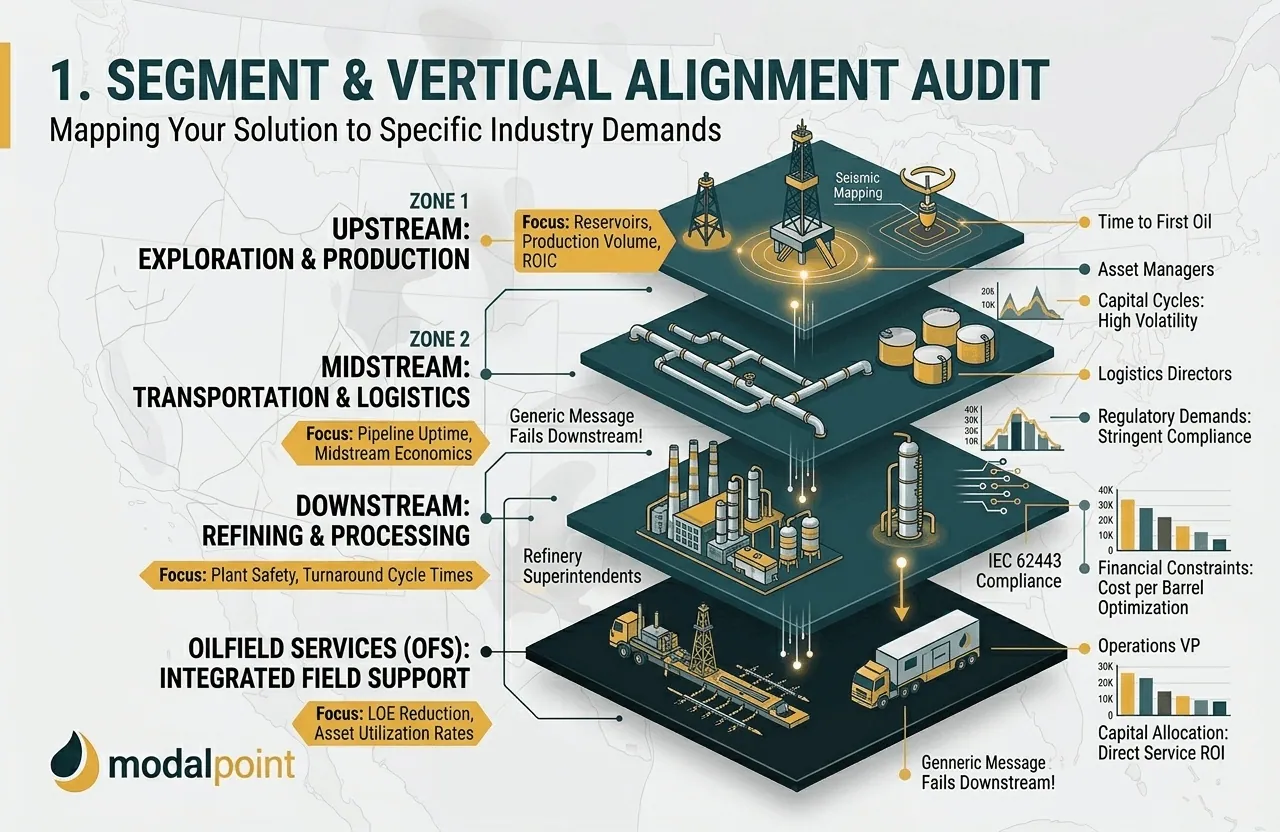
You must clearly determine whether your asset targets Upstream, Midstream, Downstream, or Oilfield Services. Each vertical operates on entirely distinct capital cycles, regulatory demands, and financial constraints. A workflow optimization tool engineered for an upstream asset manager will fail completely if marketed to a downstream refinery superintendent who is focused strictly on plant safety and turnaround cycle times.
2. Capital Buyer Persona Calibration
Stop pitching technical features to financial decision makers. Your content strategy must speak directly to specific executive roles. The Chief Financial Officer wants to understand lease operating expense reductions and capital asset protection; the Chief Technology Officer requires deep documentation on data architecture and api systems; while the Operational Vice President looks exclusively at safety and asset utilization rates.
3. Quantitative Verification of ROIC Impact
Before launching your commercial campaigns, you must precisely quantify your financial impact on Return on Invested Capital. If your solution costs fifty thousand dollars, you need to prove exactly how it protects or generates five hundred thousand dollars in capital efficiency. Clearly outline how your software or equipment lowers full-cycle breakeven costs per barrel or significantly compresses operational cycle times.
4. Technical Integration Maturity and Interoperability
Modern operators refuse to deploy isolated software silos that isolate data. Your platform must demonstrate high integration maturity right out of the gate. Ensure your system connects flawlessly with legacy SCADA networks, industrial historians, and corporate enterprise resource planning software via secure, high-performance APIs without requiring extensive custom engineering work.
5. Field-Level Uptime and Operational Resiliency
Industrial technology must be built to withstand the harshest field environments. If you are deploying edge hardware or remote monitoring sensors, you must validate their operational resilience against extreme weather, structural vibration, and continuous chemical exposure. Field operators will immediately abandon any technology that compromises asset reliability or introduces new operational safety risks.
6. Enterprise Data Governance and Cybersecurity Protocols
Data security is a critical commercial requirement for major energy producers. Your technology architecture must fully comply with strict enterprise data governance standards and industrial cybersecurity frameworks like SOC 2 Type II and IEC 62443. Be completely prepared to explain how your system handles data transmission from remote edge locations to central cloud servers without exposing the asset to security vulnerabilities.
7. Sustainability Realities and Methane Intensity Tracking
Environmental tracking is no longer optional; it is deeply embedded into corporate capital allocation strategies. Your go-to-market assets must demonstrate how your technology helps operators accurately measure, report, or reduce carbon footprint and methane intensity. Ensure your data collection models perfectly align with changing regulatory transparency requirements and ESG accounting standards.
8. Master Service Agreement (MSA) and Procurement Readiness
The technical evaluation is only half the battle; navigating the procurement process is where most startups stall out. Validate that your corporate structure, safety records, and liability insurance meet the strict vendor onboarding demands of tier-one operators. Having a pre-vetted Master Service Agreement framework ready will save months of costly legal friction during contract negotiations.
9. Value Over Volume Pricing Architecture
Traditional software licensing models do not translate well to complex industrial assets. Avoid using generic seat-based subscription structures that penalize operators for scaling usage across field personnel. Instead, design a value-driven pricing architecture tied directly to measurable operational outcomes, such as reduced non-productive time, lower barrel production costs, or extended equipment life cycles.
10. Structured Pilot-to-Commercialization Scaling Pathways
Operators frequently use small-scale field trials to test new technology without making a long-term corporate commitment. You must establish a clear contractual pathway that automatically converts a successful technical pilot into an enterprise-wide commercial deployment. Explicitly define your key performance metrics before the trial begins to prevent the project from getting permanently stuck in a pilot sandbox.
11. Ecosystem Partnerships and Basin Alignment
No industrial solution succeeds in total isolation. You must build strong strategic alliances across the broader energy ecosystem, including engineering firms, regional equipment distributors, and trusted logistics providers. Aligning your distribution network with active basins ensures your business can provide rapid field support and maintenance services exactly where operators need them.
12. AI Search Visibility and Digital Footprint Maturity
Modern procurement teams and technical executives use AI-driven search tools and large language models to source and evaluate new vendors. If your technical specifications, performance metrics, and case studies are hidden inside locked PDFs, AI platforms cannot find or recommend your business. Ensure your corporate web infrastructure is fully optimized with clean, highly structured data that AI search engines can easily parse and reference.
Establishing Long-Term Asset Authority
Sustained commercial growth requires moving far beyond short-term sales tactics. By systematically validating every item on this operational checklist, you protect your business from common deployment pitfalls and build long-term market authority. Focus on providing high-context, research-backed solutions that address the specific operational frictions, safety demands, and capital challenges faced by modern industrial operators.
True market validation means matching your technical capability with a sophisticated commercial strategy. When you align your product engineering with the exact financial drivers used by executive decision makers, you eliminate typical procurement friction and accelerate corporate adoption. Ensure your team maintains absolute focus on measurable asset efficiency, verified system security, and field-level execution to build a lasting footprint across the global market with ModalPoint.
Key Industry Benchmark:
According to a comprehensive McKinsey Operational Connectivity Report, offshore operators can successfully reduce direct capital and operational expenditures by 20 to 25 percent per barrel by deeply embedding advanced connectivity tools and field analytics into their core infrastructure assets.