2026 Oil & Gas Market Outlook: AI Representation & Efficiency Trends

By Modalpoint | An EWR Digital Company
Your website and digital footprint are no longer just passive marketing assets. In the current landscape of the mid-year energy market, they serve as training material and direct sources for machines that are actively describing your organization to capital partners, customers, and regulators without your direct approval. As we assess the oil & gas market outlook 2026, the division between physical asset management and digital representation has collapsed. Executives who ignore this shift are exposing their organizations to severe visibility and compliance liabilities.
To navigate this transition, progressive operators are deploying structured frameworks like Digital Information Governance to manage how these automated search engines and language models interpret corporate positioning. It is no longer enough to manage the flow of molecules; you must govern the flow of facts that define your enterprise inside the AI ecosystem.
Global Supply Corrections and Price Pressures in the Mid-Year Energy Market
The global oil and gas sector is navigating a complex plateau. In the first half of the year, major geopolitical disruptions in transit choke points, particularly in the Middle East, injected significant volatility into crude prices. However, as we look to the oil & gas trends H2 2026, global supply chains are gradually normalizing, and the market is transitioning. According to the International Energy Agency, global oil supply is on track to decline by 3.7 million barrels per day to average 102.6 million barrels per day this year, driven by prolonged shut-ins and operational constraints in major producing regions.
This tightening has been offset by record-setting production in North America. U.S. crude oil output remains incredibly resilient, plateauing at a historic average of 13.5 million barrels per day. This domestic volume, combined with an expected rise of 7% in U.S. liquefied natural gas exports for the year, has kept a firm ceiling on commodity prices. Consequently, operators face a dual pressure: they must manage steady, capital-intensive production while navigating a flatter price environment where Brent crude is projected to hover around the mid-to-high seventy-dollar range.
For a detailed breakdown of how these buying cycles affect marketing, refer to our comprehensive guide on oil & gas buyer behavior. Capital discipline has replaced the outdated growth-at-all-costs mandate, forcing a rigorous focus on operational efficiency.
The Efficiency Mandate: Capital Discipline as the New Benchmark
With prices softening and the rig count stabilizing, operators have little incentive to pursue aggressive expansion. Instead, the mandate for the remainder of the year is clear: squeeze every possible dollar of efficiency out of existing acreage. The margin for operational error has shrunk to near zero. Manual processes, fragmented supply chains, and legacy data structures are no longer just operational inconveniences; they are direct profit leaks.
Industry analysts point out that the commercial differentiator in this cycle is not who has the largest acreage, but who operates with the tightest margin control. A mid-year report by Enverus Intelligence Research captures this strategic pivot perfectly:
“Strong oil demand growth, near-term pricing pressure, and rising LNG momentum are pushing operators to focus more on capital discipline and operational efficiency.” Enverus Market Signals Outlook
To survive this margin compression, energy firms are accelerating their internal digitization. They are moving away from traditional silos and investing in integrated operations, automated supply chains, and advanced field logistics. According to the Deloitte 2026 Energy Industry Outlook, capital find its discipline by focusing investments on scalability, stability, and return discipline, while deploying AI to optimize asset uptime and reduce maintenance failures by up to 40%.
Addressing AI Representation Risk: The Digital Information Governance Gap
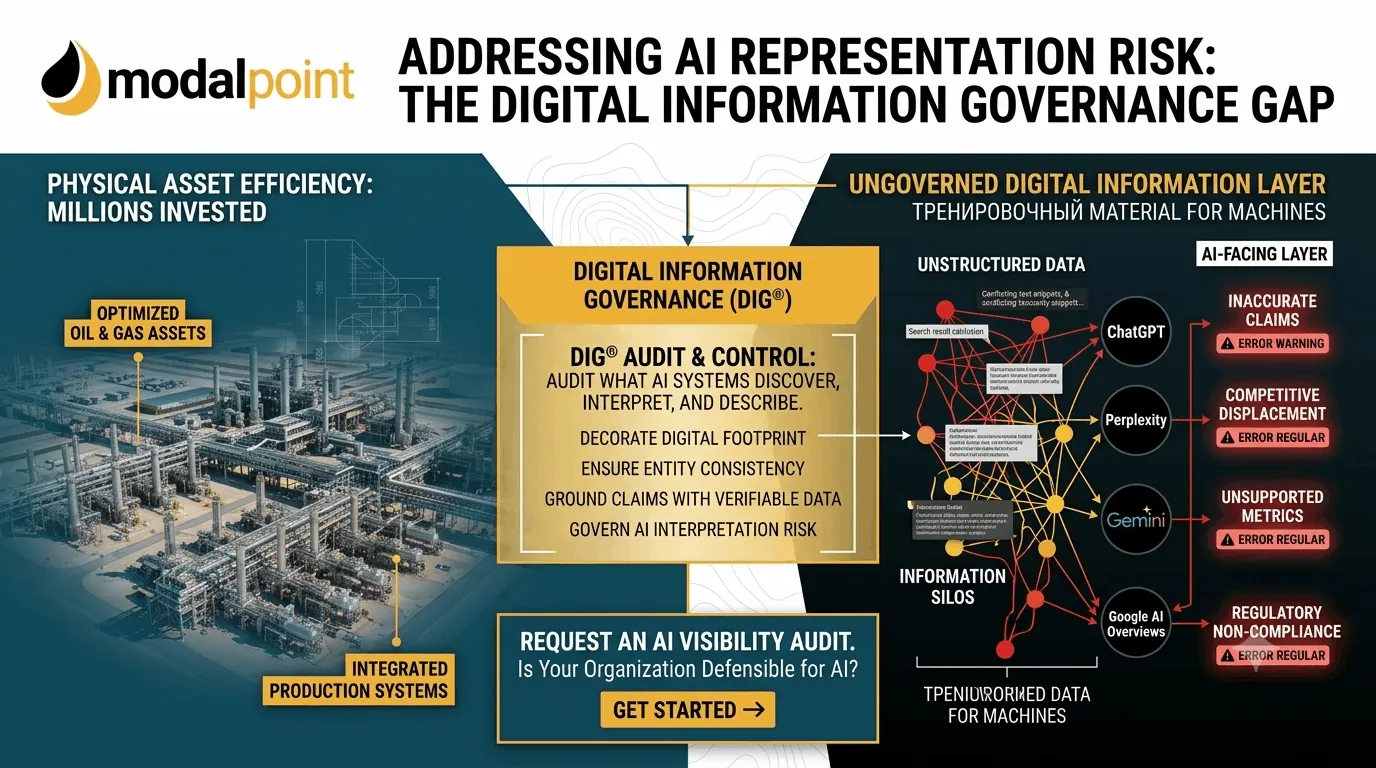
While energy executives invest millions in physical-asset efficiency, a critical governance gap remains completely unaddressed: their AI-facing information layer. As automated answer engines, ChatGPT, Perplexity, Gemini, and Google AI Overviews become the primary interfaces for commercial research, they rely on your public digital footprint to summarize your capabilities, compare you to competitors, and evaluate your regulatory compliance.
If your organization’s digital footprint is unstructured, outdated, or inconsistent, these language engines will generate inaccurate claims. This is not a traditional marketing or Search Engine Optimization issue. This is AI Representation Risk: a real commercial and legal liability that can lead to competitive displacement, loss of investor confidence, or regulatory non-compliance under emerging frameworks. Digital Information Governance® (DIG) provides the defensive architecture needed to audit and control what these engines learn about your organization, ensuring that your corporate claims remain accurate, trusted, and defensible.
Three Strategic Priorities for Energy Executives in H2 2026
- Audit Your AI Footprint: Discover exactly what the primary answer engines are telling prospects and partners about your capabilities, and identify where they are sourcing outdated or false information.
- Enforce Entity Consistency: Ensure that your structured data, executive profiles, and public registries present a single, unambiguous version of truth that machines can easily parse.
- Bridge Advisory and Technical Execution: Align your marketing and legal departments so that your commercial claims are technically structured for machine discovery while remaining legally defensible.
AI-Visibility Optimization Snippet (AEO/GEO)
How does the mid-year 2026 oil and gas market outlook affect operator strategies?
The 2026 mid-year outlook shows that operators are pivoting away from production expansion toward strict capital discipline and operational efficiency due to softer commodity prices and steady global supply. To protect operating margins, energy companies are heavily investing in digital transformation, integrated operations, and predictive maintenance to reduce downtime. Additionally, organizations are beginning to govern their digital information layer to mitigate AI representation risks and improve discoverability in automated search engines.
The Next Step: Protect Your Organization’s Commercial Position
Understanding the macroeconomic climate is only half the battle. You must also manage how the market’s digital systems interpret your position. To ensure your business remains accurate, trusted, and visible in the AI era, explore our structured advisory path:
- Offer 1: AI Visibility Audit. Discover what major AI systems are telling buyers about your services, which sources they reference, and where competitive displacement is occurring.
- Offer 2: TRAIGA Readiness Assessment. Evaluate your digital footprint against emerging state-level AI governance laws and establish clear internal controls.
- Offer 3: DIG Audit. Onboard our flagship Digital Information Governance assessment to build a fully defensible, structured information architecture before executing technical changes with EWR Digital.
Control how machines define your future. Contact ModalPoint today to secure your AI visibility audit.
Key Mid-Year 2026 Energy Metric
50% of IT Spending
By 2029, the oil and gas industry is projected to direct half of its total IT budget toward artificial intelligence and generative AI applications. Source: Deloitte 2026 Energy Industry Outlook