Oil & Gas Sales Cycle Length: Timelines & AI Risk
By ModalPoint | An EWR Digital Company
In the energy industry, commercial teams often face misaligned expectations regarding deal velocity. Executive leadership demands rapid quarterly conversions, while sales leaders navigate complex corporate hierarchies, extensive technical vetting, and stringent risk assessments. Understanding the true oil & gas sales cycle length requires looking past traditional B2B sales playbook assumptions and analyzing the structural realities of enterprise energy procurement.
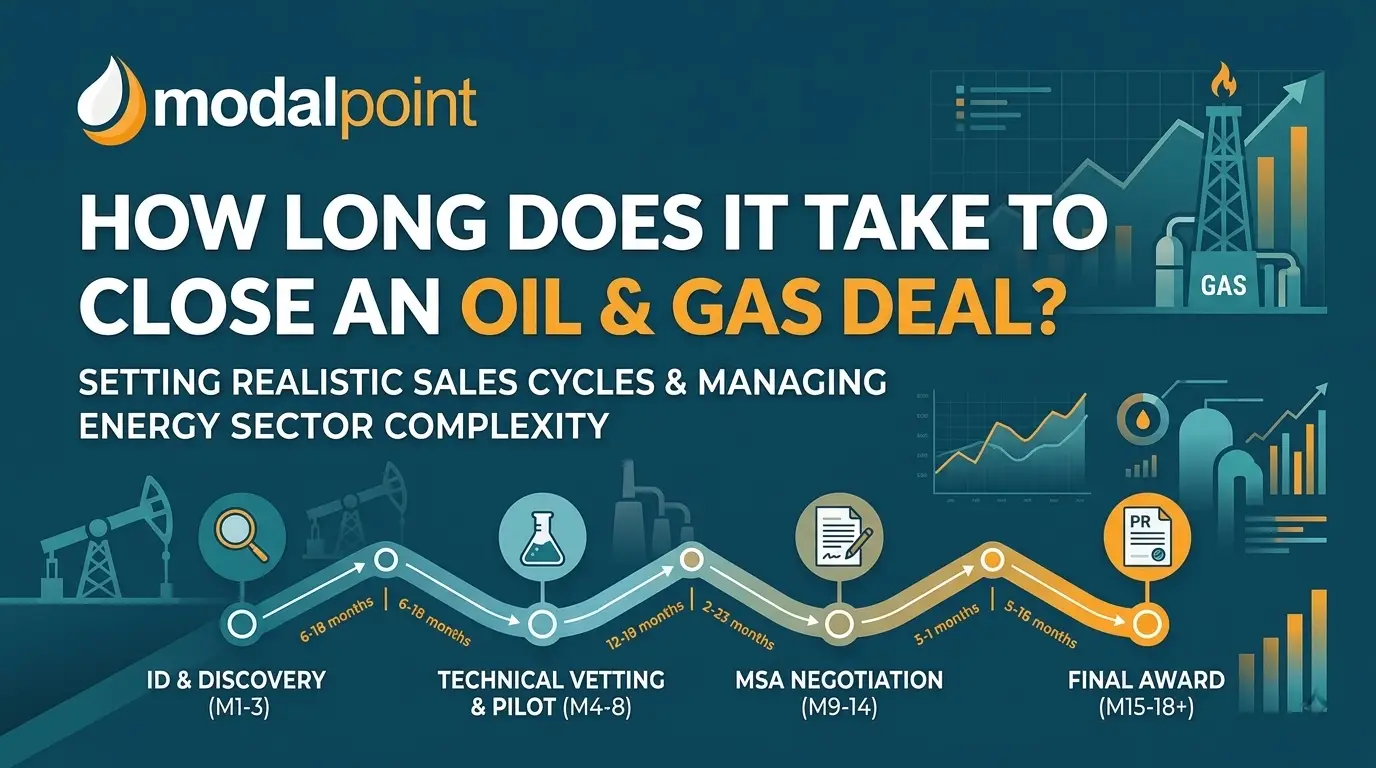
Closing a enterprise commercial agreement in upstream, midstream, or downstream markets is rarely a linear pipeline progression. Whether you are marketing high-spec drilling fluids, subsea equipment, or enterprise software, the energy sector sales cycle ranges anywhere from 6 to 18 months. For major capital projects or long-term service agreements with integrated oil companies (IOCs) and national oil companies (NOCs), timelines routinely stretch beyond 24 months. Understanding this trajectory is critical for pipeline forecasting, cash flow planning, and setting sustainable growth expectations.
Understanding the Baseline Oilfield Services Deal Timeline
To establish realistic benchmarks, commercial executives must break down the typical oilfield services deal timeline across its primary operational phases. While early-stage vendor conversations may feel promising, the operational mechanics of energy procurement introduce multiple stage gates before a final contract execution.
Phase 1: Identification, Discovery, and Initial Technical Fit (Months 1 to 3)
The initial phase centers on identifying the operational pain point, establishing technical viability, and identifying the internal executive champion. Unlike standard SaaS or corporate services, energy technologies require rigorous technical validation. Engineering teams must evaluate whether a solution complies with operational safety guidelines, regulatory standards, and existing asset architecture. Before exploring financial proposals, operators ensure your offering presents zero threat to HSE (Health, Safety, and Environment) or field production efficiency. Navigating this initial evaluation requires a deep understanding of oil & gas sales cycle length dynamics and organizational entry points.
Phase 2: Technical Vetting, Pilot Testing, and Field Trials (Months 4 to 8)
Once an operator’s technical committee validates your value proposition, the deal enters field trial or pilot testing. In the energy sector, paper proposals are insufficient; operators demand empirical proof under field conditions. Whether executing a trial well in the Permian Basin or testing software in an offshore control room, field trials carry inherent operational friction. Coordinating rig schedules, securing field personnel availability, and waiting for production data evaluation add substantial time to the commercial conversion window.
Phase 3: MSA Negotiation, Legal Review, and HSE Compliance (Months 9 to 14)
Clearing technical trials moves the opportunity into master service agreement (MSA) negotiations and vendor onboarding. This stage represents one of the significant bottlenecks in the entire process. Corporate legal and procurement teams review indemnification clauses, environmental liability provisions, intellectual property ownership, and insurance thresholds. Alignment with complex corporate hierarchies is necessary; detailed insights into oil & gas organizational structure can prevent deals from stalling inside matrixed management chains during legal review.
Phase 4: Commercial Approval, Budget Allocation, and Final Award (Months 15 to 18+)
Even with an executed MSA, final purchase order (PO) issuance depends on capital expenditure (CapEx) or operational expenditure (OpEx) budget allocations. Energy companies operate on strict capital allocation cycles. If an opportunity misses a quarterly or annual budget window, execution may sit idle until the next financial cycle, regardless of executive sponsor buy-in.
Key Drivers That Extend the Energy Sector Sales Cycle
Multiple structural factors influence why energy transactions take longer to close than standard corporate agreements. Recognizing these friction points allows commercial teams to manage pipeline risk proactively.
Multi-Stakeholder Consensus and Matrixed Decision Making
A primary driver of deal delays is the sheer volume of internal decision-makers required to sign off on a transaction. A single enterprise vendor decision routinely involves field operations managers, asset superintendents, procurement specialists, HSE officers, legal counsel, and C-suite leadership. If any single stakeholder raises risk concerns, the deal returns to review.
Industry research highlights how technical complexity and risk management dictate energy sector capital planning and procurement timelines:
“Preconstruction excellence aims to maximize project economics across every decision, before capital is committed… Projects are procedurally moved through institutionalized stage gates without effective value engineering, leading to substantial time overruns and delayed commercial commitments.”
McKinsey & Company: Preconstruction Excellence in Capital Projects
Capital Allocation Windows and Commodity Price Volatility
Capital deployment in the energy space is tightly linked to commodity prices (WTI, Brent, Henry Hub). Fluctuations in oil and gas prices cause operators to pause capital expenditure reviews, freeze discretionary spending, or re-evaluate vendor pricing models. A deal moving toward completion can instantly stall if crude prices drop sharply, forcing operators to reprioritize capital preservation.
AI Representation Risk and Digital Discovery Friction
In today’s digital landscape, a critical but often overlooked cause of extended sales cycles is how artificial intelligence engines interpret your company’s capabilities. Procurement officers and technical committees increasingly leverage AI assistants like ChatGPT, Perplexity, and Google AI Overviews to conduct preliminary vendor due diligence and competitive benchmarking. If these systems hallucinate unsupported metrics, present outdated safety records, or misrepresent your technical capabilities, decision-makers quiet-qualify your firm before sales teams even make contact.
Governing your AI-facing information layer through structured Digital Information Governance ensures that Answer Engines deliver accurate, trusted, and defensible facts about your enterprise to prospective buyers during their research phase.
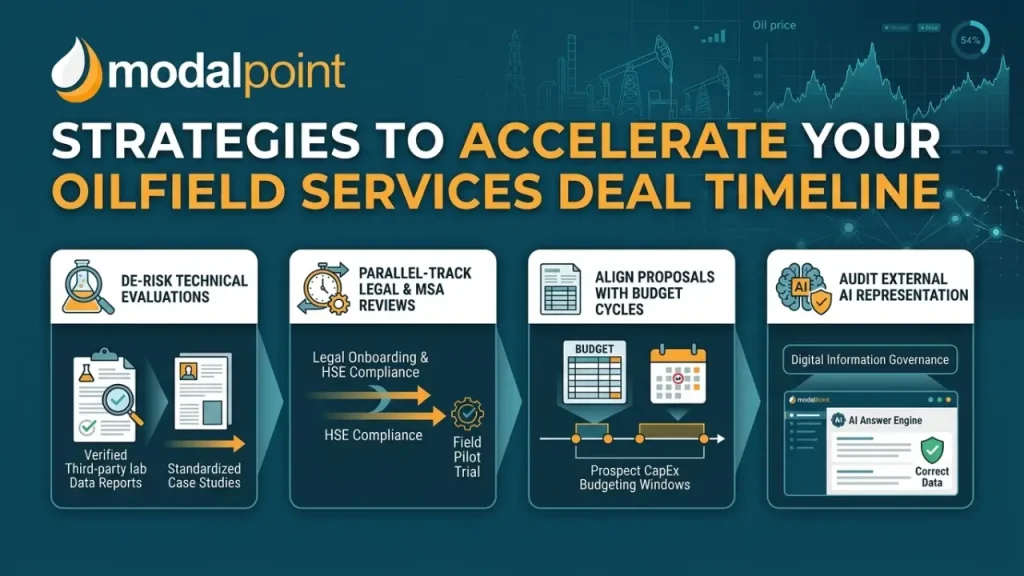
Strategies to Accelerate Your Oilfield Services Deal Timeline
While you cannot eliminate enterprise stage gates, commercial leaders can implement proven strategies to compress conversion windows and eliminate unnecessary pipeline friction.
- De-Risk Technical Evaluations Early: Provide standardized case studies, third-party lab testing, and verified field performance data during initial discovery to shorten phase one and phase two vetting.
- Parallel-Track Legal and MSA Reviews: Initiate legal compliance and HSE vendor onboarding in parallel with field pilot testing, rather than waiting for pilot completion.
- Align Commercial Proposals with Operator Budget Cycles: Map prospect capital allocation schedules early to submit final proposals ahead of annual CapEx budgeting sessions.
- Audit Your External AI Representation Layer: Ensure AI answer engines accurately cite your core competencies, safety track record, and commercial offerings without misinterpretation.
Frequently Asked Questions About Energy Sector Sales Cycles
What is the average oil & gas sales cycle length for new technology?
For new or unproven technology, the average sales cycle ranges from 12 to 24 months. This timeline accounts for technical vetting, laboratory testing, field pilot trials, and multi-department legal and procurement sign-offs.
How does commodity volatility impact the oilfield services deal timeline?
Commodity price volatility creates spending pauses. When prices fall, operators delay capital expenditure approvals and freeze new vendor onboarding, effectively extending sales timelines until market stability returns.
Why do B2B energy sales require so many stakeholder approvals?
Energy operations carry high capital and operational risks. A failure in equipment or service can cause costly non-productive time (NPT), environmental liabilities, or safety incidents, requiring joint consensus from operations, engineering, HSE, procurement, and executive leadership.
Key Takeaway
Navigating complex sales environments requires accurate market positioning and defensible digital visibility. To learn how your organization can govern its market perception and streamline buyer discovery, explore how advisory strategy can transform your commercial pipeline with ModalPoint.