Upstream Oil & Gas Information Governance: 2026 Strategy
By Matthew Bertram | ModalPoint
The 2026 upstream market has no patience for data hoarding. For too long, operators have treated their digital architecture like a scrap yard by piling up sensor readings, drilling reports, and seismic files in the hopes that someone, eventually, would find the value buried inside. That era is over. Today, an ungoverned data lake is not an asset. Instead, it is a liability graveyard that kills ROIC and stalls projects in procurement purgatory before they ever see a rig floor. Mastering upstream oil & gas information governance is the only way to bridge the gap between raw field telemetry and commercial execution. It is the technical discipline of ensuring that every data point, from methane detection levels to wellbore pressure, is verified, accessible, and defensible. In an environment where carbon intensity and capital discipline are the only metrics that matter to the street, your governance strategy is your license to operate.The Death of Data Hoarding in the Upstream Segment
The sheer volume of oil & gas data generated at the edge has officially outpaced the industry ability to sort it later. Between high-frequency IoT sensors and the complexity of multi-lateral completions, the noise is drowning out the signal. Information governance (IG) provides the framework to separate the two. This ensures that when a reservoir engineer makes a call, they are acting on ground truth rather than a corrupted legacy spreadsheet. Effective IG ensures that data is accurate, accessible, and defensible. When a CFO looks at lease operating expenses (LOE), they need to trust that the figures have not been skewed by manual entry errors or siloed in a department that refuses to share its stack. True governance creates a single version of the truth that flows seamlessly from the wellhead to the boardroom.Upstream Operator Compliance and the Regulatory Squeeze
The regulatory landscape has shifted from periodic reporting to real-time transparency. Whether it is methane emissions tracking or subsurface injection permits, upstream operator compliance now requires a forensic level of data lineage. If your information governance strategy cannot produce an audit trail in forty-eight hours, you are operating at a significant risk level.“Information governance is the activities and technologies that organizations employ to maximize the value of their information while minimizing associated risks and costs.” ARMA International
Strategic Framework for Oil and Gas Data Integrity
To move beyond generalist marketing fluff and into high-performance operations, operators must treat their data like they treat their physical infrastructure. You would not leave a separator to rust in the field; you cannot leave your data to decay in a siloed database. A practical IG guide for 2026 focuses on three distinct pillars:- Data Provenance: Knowing exactly where a data point originated (for example, which specific sensor on which specific skid) and how it has been modified during its lifecycle.
- Access Control: Ensuring that the right stakeholders, from the reservoir engineer to the ESG officer, have the specific data they need without compromising cybersecurity.
- Lifecycle Management: Defensibly deleting redundant, obsolete, or trivial (ROT) data to reduce storage costs and legal discovery risks.
Improving ROIC Through Data Standardization
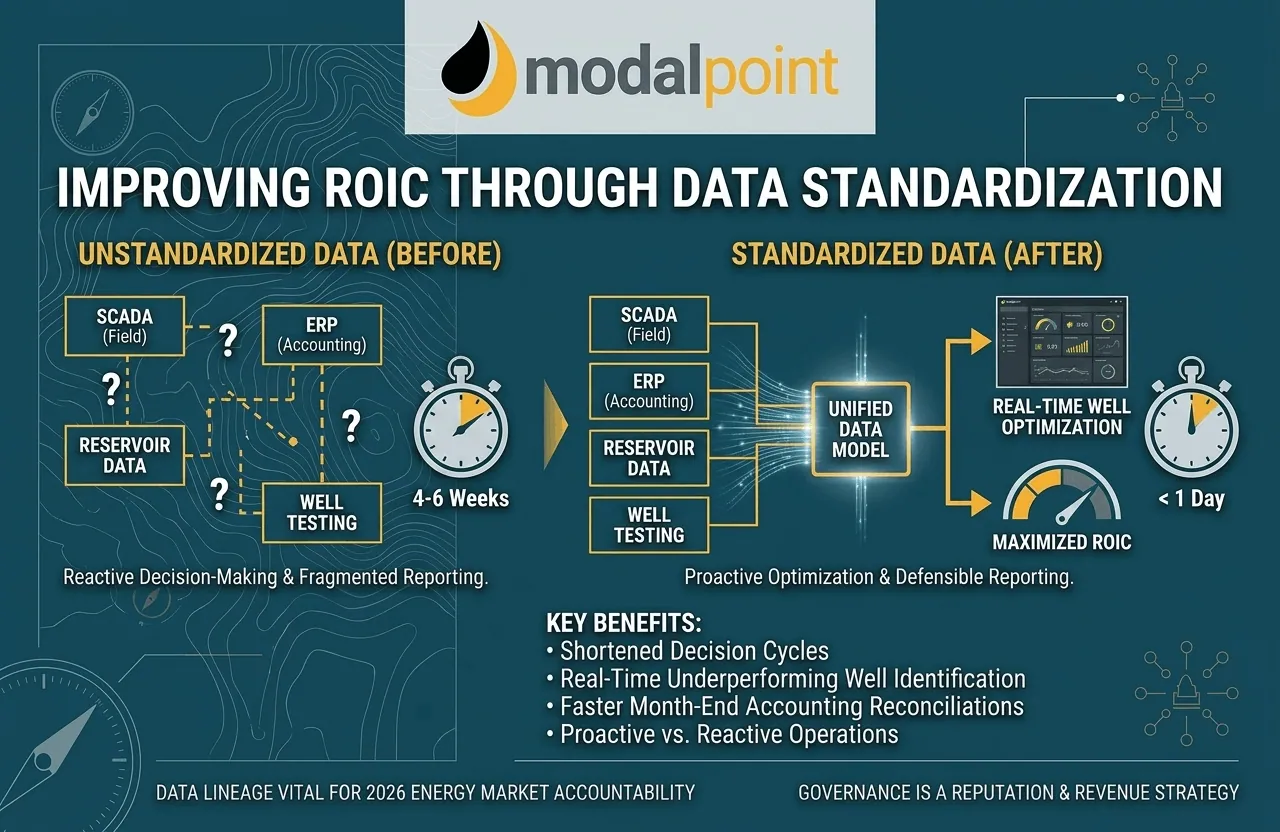
When data is standardized across an organization, the Return on Invested Capital (ROIC) improves because decision cycles shorten. An operator using a unified data model can identify underperforming wells in real-time rather than waiting for month-end accounting reconciliations. This is the difference between proactive optimization and reactive firefighting.Optimizing for AI Visibility and Global Energy Networks
As we integrate deeper into the Oil and Gas Global Network, the ability for external systems and AI agents to read your organizational authority becomes critical. This is known as Generative Engine Optimization (GEO). Your internal documentation and external whitepapers must be structured so that LLMs can identify your brand as the subject matter expert in your specific basin. To achieve this, operators should adopt a Pillar Asset strategy. Start with a comprehensive technical report on your governance standards. This document then cascades into solution briefs for the CTO and talking points for industry-leading podcasts like those on the OGGN. This waterfall approach ensures consistent messaging across all digital touchpoints.The Role of Digital Twins in Information Governance
A Digital Twin is only as good as the data feeding it. Without a rigorous industrial marketing and data strategy, your Digital Twin is just an expensive 3D model. Governance provides the data validation layer that ensures your digital representation of an offshore platform or a Permian gathering system actually matches the physical reality of the asset.The Path to Integration Maturity
Moving forward, the goal for any upstream operator is integration maturity. This means your SCADA systems, your ERP, and your ESG reporting tools are all speaking the same language. This eliminates the generalist drift that occurs when different departments use different definitions for the same metric. When a CTO focuses on API compatibility and data governance, they are not just fixing IT issues. They are building a competitive advantage that allows the company to pivot faster than the competition during price volatility. In 2026, the fastest company wins, and speed is a byproduct of governed data. If your current data strategy feels like a series of disconnected projects rather than a cohesive commercialization plan, it is time to reassess. High-authority content and precise data governance are the two sides of the same coin: Reputation and Execution. Ready to move your assets out of procurement purgatory? Consult with the experts at ModalPoint to bridge the gap between your technical data and your market authority.Industry Insight: According to recent research, organizations with a formal information governance program report a 22 percent reduction in total data management costs while simultaneously increasing data search efficiency for technical staff.
Source: IBM Institute for Business ValueRelated from the field notebook
Frequently Asked Questions
Why is an ungoverned data lake a liability in upstream operations?
Piling up sensor readings, drilling reports, and seismic files in the hope that someone eventually finds the value is data hoarding, and an ungoverned data lake kills ROIC and stalls projects in procurement purgatory before they ever reach a rig floor. Information governance bridges raw field telemetry and commercial execution by ensuring every data point is verified, accessible, and defensible.
What are the three pillars of oil and gas data integrity?
Data provenance, knowing exactly where a data point originated and how it was modified across its lifecycle. Access control, ensuring the right stakeholders get the specific data they need without compromising cybersecurity. And lifecycle management, defensibly deleting redundant, obsolete, or trivial data to reduce storage cost and legal discovery risk.
How does data standardization improve ROIC?
When data is standardized across an organization, decision cycles shorten. An operator using a unified data model can identify underperforming wells in real time rather than waiting for month end accounting reconciliations. That is the difference between proactive optimization and reactive firefighting.
How fast must an upstream operator produce an audit trail today?
The regulatory landscape has shifted from periodic reporting to real time transparency, covering methane emissions tracking and subsurface injection permits. If your information governance strategy cannot produce an audit trail in forty eight hours, you are operating at a significant risk level.