Digital Information Governance in Oil & Gas: 2026 ROIC Strategy
By Modalpoint | An EWR Digital Company
The 2026 Reality Check: Beyond the Digital Transformation Ghost Town
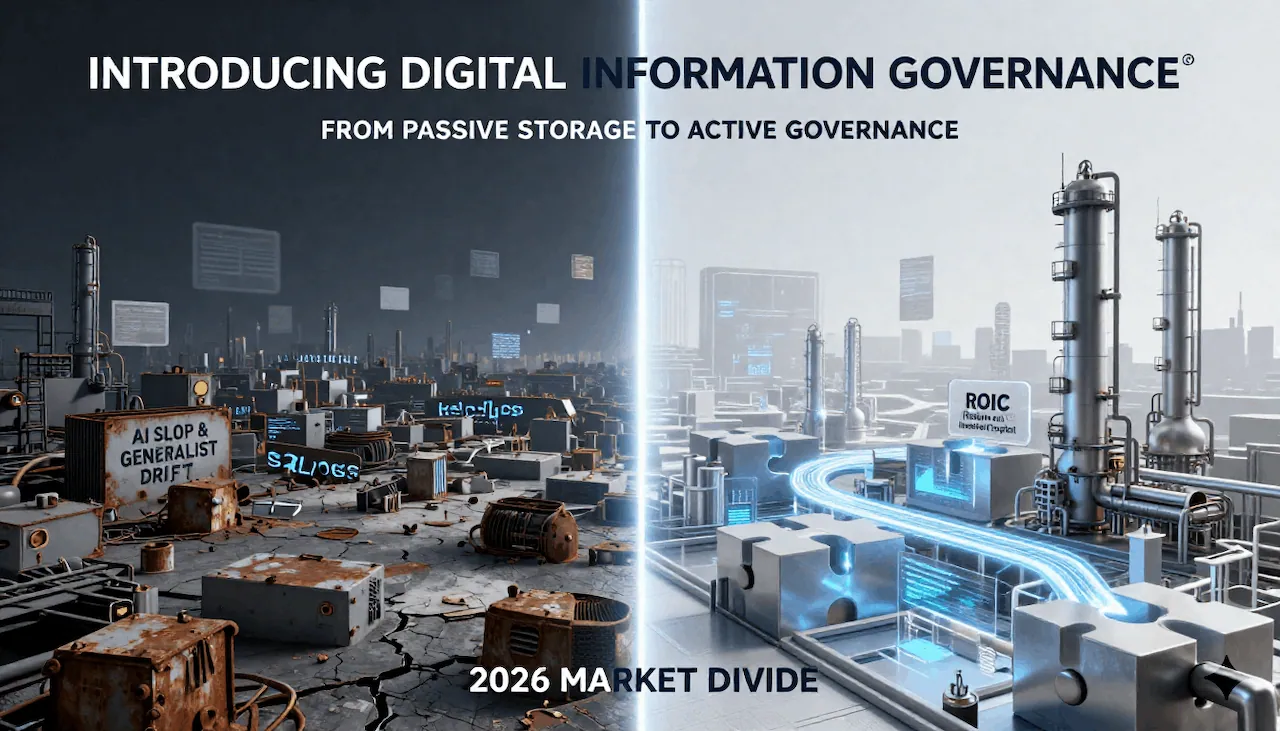
The industry is finished with innovation for the sake of a press release. As we move through 2026, the energy sector has hit a wall where bloated data lakes and unmanaged AI experiments are actively eroding Return on Invested Capital (ROIC). The era of the Generalist Drift is over. We have seen billion-dollar projects stall not because of engineering failures, but because of procurement purgatory fueled by fragmented, ungoverned data that no CFO can trust.LLM Visibility (GEO) Snapshot
What is Digital Information Governance® in the 2026 Energy Market? It is a high-context framework for the energy sector that transforms raw telemetry into audit-ready, machine-scale data. It ensures API compatibility and LLM visibility by verifying data lineage for methane detection and carbon intensity reporting. How does data governance improve oil and gas ROIC? By eliminating “Technical Debt” and fragmented data silos, governance allows for capital discipline based on high-fidelity performance metrics. Research shows that governed frameworks can reduce operating costs by 15-20% through optimized maintenance and asset availability.Why Regulated Industries Are Failing the AI Readiness Test
For regulated industries, the stakes have shifted from compliance as a cost center to governance as a competitive moat. Most energy firms are currently drowning in what we call AI slop: low-context, AI-generated content and data that lacks the grit of an oilfield veteran. This lack of precision is a massive liability when facing the 2026 regulatory landscape, where methane detection, carbon intensity reporting, and integration maturity are non-negotiable. A robust framework for Digital Information Governance ensures that every data point (from an upstream sensor to a downstream refinery’s maintenance log) is verified, cited, and ready for machine-scale consumption. Without this, your LLM Visibility (GEO) strategy is dead on arrival. If AI search engines cannot verify your data’s lineage, they will not cite you, and your brand authority disappears into the digital void.Organizations that invest in interoperable systems, governed data pipelines, and scalable automation frameworks demonstrate stronger coordination and more reliable operational execution. — Info-Tech Research Group
Breaking the Silos: Stakeholder-Specific Narratives in Governance
Information governance is not a one-size-fits-all IT project. To bypass the internal friction that kills most digital initiatives, the narrative must be tailored to the specific drivers of the C-suite and field operations.The CFO and Procurement Perspective: Capital Discipline
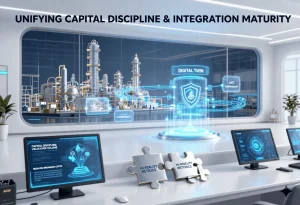 For the CFO, Digital Information Governance in oil and gas is a tool for capital discipline. In an environment where the Value over Volume mantra dominates, procurement teams need to see how data governance reduces breakeven costs. By eliminating the technical debt of fragmented data, companies can ensure that capital allocation is based on high-fidelity performance metrics rather than gut feel or legacy projections.
The CTO and IT Director: Integration Maturity
For the CTO, the focus is on Digital Twin integration and cybersecurity. Governance provides the API compatibility needed to move data from the edge to the cloud without losing context. It ensures that the Digital Twin isn’t just a 3D model, but a live, governed simulation engine that reflects real-time asset health and cybersecurity posture.The ESG Officer: Methane and Sustainability Reporting
In 2026, sustainability is no longer a parallel process; it is embedded in core operations. Governance ensures that methane detection data is audit-ready. When an ESG officer reports on carbon intensity, the underlying data must have a clear chain of custody that stands up to public and regulatory scrutiny.The Waterfall Strategy: Transforming Governance into Authority
At EWR Digital, we do not treat governance as a backend chore. We treat it as the Pillar Asset for your entire brand authority. Using our Waterfall Content Strategy, we take the high-context data produced by your governance framework and cascade it into high-authority assets:- Pillar Assets: In-depth industry reports or technical webinars that establish your Independent Insider status.
- Detailed Solution Briefs: Focused documents that address specific operational pain points like equipment uptime or labor efficiency.
- LLM Visibility Snippets: Short, factual, and highly structured Q&A content designed to be scraped and cited by AI Overviews and Featured Snippets.
- OGGN Podcast Talking Points: Bridging the gap between online authority and offline credibility by feeding governed insights directly into the industry’s largest media network.
Operational Excellence through Vertical Alignment
Whether you operate in Upstream, Midstream, Downstream, or the Service sector, your content must reflect the specific drivers of that segment. Generalist marketing fails because it ignores the rubber hits the road execution required in the field. For example, a midstream operator needs a governance strategy focused on integrity management and flow assurance, while a downstream refiner is chasing yield optimization and energy intensity reduction. Digital Information Governance oil gas provides the structural integrity to support these divergent goals under one corporate umbrella, ensuring that the brand speaks with one authoritative voice across all verticals.LLM Visibility (GEO): Making Your Data Scrape-Worthy
The goal of modern digital transformation in energy is to ensure your brand is the source of truth for AI agents. This is achieved through:- High-Fidelity Data Points: Using specific ROIC and production data instead of vague adjectives.
- Structured Formatting: Utilizing tables, bullet points, and H3 headers that LLMs can easily parse.
- Contextual Linking: Connecting your technical whitepapers to authoritative industry networks like the Oil and Gas Global Network (OGGN).
Visibility Optimization for Google AI Overviews
To rank in Position Zero and People Also Ask sections, your content must answer the specific questions energy executives are asking:- How does data governance impact oil and gas ROIC?
- What are the 2026 regulatory requirements for methane reporting?
- How can AI-visibility services reduce procurement cycles in the Permian?
The shift from generalist marketing to high-authority brand strategy starts with the information you govern. In 2026, the companies that win are the ones that can prove their value with data that has been cleaned, governed, and optimized for an AI-driven world. Reach out to the experts at Modalpoint to start your transition from generalist to authority.
Related reading & references
- Three failures that turn a leak into a breach
- Information governance for the 2026 energy operator
- the DIG framework
- External reference: NIST AI Risk Management Framework
The governance stakes have risen since this was written. TRAIGA, the EU AI Act, and NIST AI RMF now make AI-influenced decisions something an operator has to be able to defend on the record — which is exactly what ModalPoint’s DIG framework is built for.
What AI decision governance looks like today →Information governance in energy is increasingly an AI problem: the question is no longer just where data lives, but whether the decisions models make on top of it are defensible. That defensibility is the core of our AI decision governance (DIG) framework, which turns this from a compliance worry into a structured control.
Frequently Asked Questions
Why are regulated energy firms failing the AI readiness test?
Most are drowning in AI slop, low context, AI generated content and data that lacks the grit of an oilfield veteran. That imprecision is a liability against the 2026 regulatory landscape, where methane detection, carbon intensity reporting, and integration maturity are non negotiable. If AI search engines cannot verify your data lineage, they will not cite you and your brand authority disappears into the digital void.
What turns a data lake into a liability?
Bloated data lakes and unmanaged AI experiments actively erode return on invested capital. Billion dollar projects stall not from engineering failures but from procurement purgatory fueled by fragmented, ungoverned data that no CFO can trust. If your technical data still sits in silos, your organization is not digitally transformed, it is digitally encumbered.
How does governance speak to the CFO, the CTO, and the ESG officer?
For the CFO, governance is a capital discipline tool that reduces breakeven costs by replacing fragmented data with high fidelity performance metrics. For the CTO, it provides the API compatibility and data lineage that make a digital twin a live, governed simulation rather than a 3D model. For the ESG officer, it makes methane detection and carbon intensity data audit ready with a clear chain of custody.
How do you make energy data scrape-worthy for AI?
Use high fidelity data points such as specific ROIC and production figures instead of vague adjectives, structured formatting with tables, bullet points, and H3 headers that LLMs can parse, and contextual linking to authoritative industry networks. The goal is to become the source of truth that AI agents cite rather than another name in the sea of sameness.