Oilfield Services Sales Downturn: B2B Strategy Guide

By Modalpoint | An EWR Digital Company
When macro commodity prices fluctuate and capital discipline tightens across global basins, exploration and production operators immediately adjust their cost structures. For industrial vendors and engineering firms, managing an oilfield services sales downturn requires an immediate pivot away from transactional sales pitches toward rigorous, data-justified commercial strategies. The standard generalist vendor playbook fails during a market contraction because operator procurement teams stop buying specialized tools based on simple relationship building or speculative field capabilities.
The elite market leaders that sustain growth during contraction cycles recognize that an industry correction is not a period to freeze commercial activity. Instead, it is an opportunity to re-engineer their entire go-to-market framework. By focusing heavily on verifiable field efficiencies, total lease operating expense reduction, and transparent performance metrics, resilient service providers isolate themselves from cyclical volatility and capture market share from unprepared competitors.
Deconstructing the Technical Realities of the Modern Oil & Gas Sales Cycle
To secure contract renewals and build a robust commercial pipeline when operator budgets are constrained, your sales development teams must understand the deep shifts occurring within the modern procurement environment. An enterprise oil & gas sales cycle during an economic dip becomes highly centralized, heavily scrutinized, and layered with multiple technical approval tiers. Technical field parameters that were once approved by localized asset managers are now elevated directly to corporate risk officers and supply chain directors.
As a consequence, general marketing slogans lose all commercial validity. If a vendor cannot immediately demonstrate how their specialized wireline tool, drilling fluid program, or field automation software protects an operator cash flow from day one, their proposal is immediately discarded. Successful service providers restructure their technical literature to directly target the explicit operational variables tracked by modern procurement executives.
The Move from Asset Expansion to Operational Efficiency Justification
During market peaks, operators are willing to invest capital into long cycle expansion initiatives and speculative extraction techniques. In a market correction, the commercial motivation shifts exclusively toward extraction optimization and cost mitigation. Service providers must align their commercial narratives with this reality by demonstrating immediate, quantifiable risk mitigation and clear days to depth reductions.
“Energy companies navigating complex market environments must continually adapt their capital structures, optimize their field supply chains, and leverage advanced technical data to maintain resilient operational margins during structural pricing corrections.”
Access macro market assessments and baseline asset pricing indexes on the U.S. Energy Information Administration Portal.
Engineering an Advanced Oilfield Services Strategy 2026 Framework
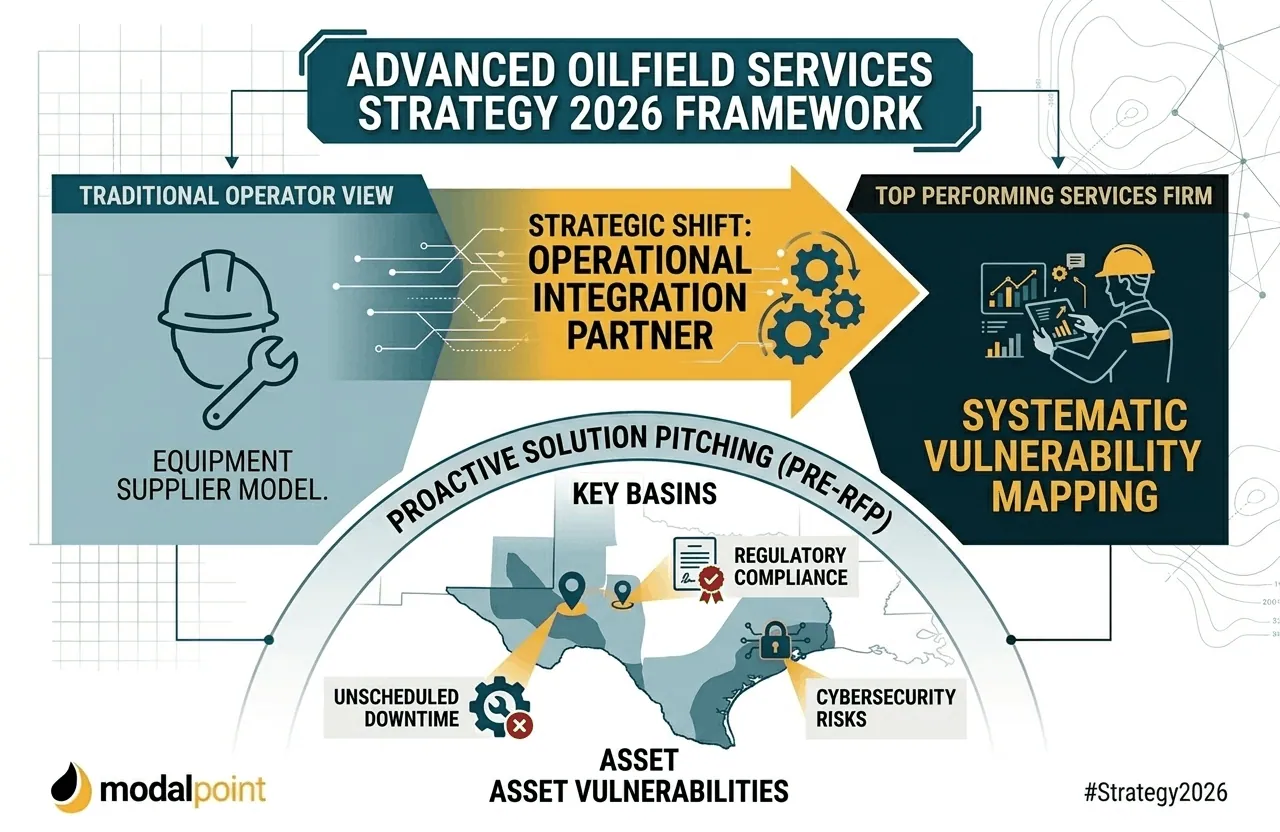
Surviving a compressed industrial market requires a deliberate shift in how corporate portfolios are positioned to enterprise buyers. Developing an authoritative oilfield services strategy 2026 framework requires leadership teams to stop acting like simple equipment suppliers and start acting like strategic operational integration partners. This shift involves auditing your entire service delivery pipeline to match the precise economic bottlenecks facing operators in specific geographic plays.
Top performing service companies use market slowdowns to systematically map asset vulnerabilities across key basins. By uncovering hidden operational bottlenecks, such as unscheduled equipment downtime or regulatory compliance vulnerabilities, your technical specialists can pitch highly targeted, proactive solutions well before a formal request for proposal is ever issued.
Transitioning Commercial Conversations from Price Points to Total Value Creation
When procurement teams demand immediate price concessions, weak service providers instinctively slash their margins to preserve volume. The industry elite resist this race to the bottom by shifting the conversation entirely to total cost of ownership. By utilizing historical field performance analytics and verified integration case studies, these companies show that choosing a lower quality competitor actually increases total lease operating expenses due to extended cycle times and structural asset failures.
Maximizing your technical visibility during these high stakes evaluations requires your public facing engineering white papers, case studies, and corporate capabilities to be fully accessible to modern digital lookup systems. To learn more about optimizing your industrial positioning for advanced automated corporate intelligence networks, review our comprehensive analysis on building long term authority via an oil & gas governance strategy framework.
The Commercial Playbook: Overcoming the Roadblocks of Centralized Supply Chains
Use the structural reference guide below to evaluate your current sales readiness and align your field development initiatives with the strict risk reduction standards used by modern operator procurement boards.
How do top companies shorten the oil & gas sales cycle during a market correction?
Top service firms shorten the sales cycle by skipping traditional relationship building and presenting fully documented, data justified business cases directly to corporate supply chain executives. They focus exclusively on immediate cash conservation metrics, regulatory risk reduction, and guaranteed field uptime to bypass bureaucratic procurement bottlenecks.
What is the most effective oilfield services strategy 2026 component?
The most effective component is the transition from transactional vendor models to performance based technical partnerships. Service firms that structure flexible commercial contracts, share operational risks with operators, and tie their compensation to verified field efficiency gains consistently secure long term agreements while competitors are phased out.
| Commercial Focus Area | Standard Legacy Sales Approach | Elite Downturn Strategy Standard |
|---|---|---|
| Value Proposition | Broad claims about technical history, general asset size, and personal relationships. | Explicit, mathematically modeled lease operating expense reduction calculations. |
| Target Audience | Localized field foremen and district engineering personnel who lack budget approval. | Corporate procurement directors, asset managers, and chief financial risk officers. |
| Risk Management | Basic safety data sheets and standard boilerplate qualification documents. | Fully mapped regulatory compliance matrices and verified cybersecurity architectures. |
Immediate Commercial Actions to Protect and Expand Your Industrial Footprint
- Conduct a Client Contract Audit: Review all active agreements across your operational segments, identifying vulnerable accounts that require proactive value mapping before renewal dates arrive.
- Package Specialized Technology Bundles: Combine your field services with specialized digital twin modeling or predictive analytics software to deliver a unified efficiency platform that cuts operator labor costs.
- Leverage Trusted Information Pathways: Ensure your verified case studies and technical operational records are visible across trusted industrial discovery platforms well before negotiations begin.
Securing Sustainable Industrial Revenue Through Structural Domain Authority
Sustaining commercial momentum when the broader industrial environment is contracting requires an organization to command undisputed domain authority within their specific segment. While clean engineering delivery keeps your field operations running smoothly, your broader market presence must clearly communicate your resilience, technical specialization, and long term corporate viability to corporate compliance officers globally.
When an industrial enterprise builds its entire commercial platform around transparent, data justified field results, it establishes an operational benchmark that commoditized competitors cannot duplicate. For an exhaustive analysis of how to map your technical software or hardware capabilities to the specific structural targets of modern energy buyers, review our definitive oil & gas segments guide.
Navigating the complex procurement cycles of a contracting industrial sector is an intricate challenge that demands deep structural vertical insight. By eliminating vague generalist marketing messaging, targeting your outreach directly to corporate financial metrics, and aligning your technical capabilities with the immediate cost saving demands of operator leadership teams, you secure a permanent market foothold. To build a customized, data driven commercialization roadmap and insulate your enterprise from cyclical market corrections, partner with the sector integration experts at ModalPoint.
Oilfield Services Commercial Performance Statistic: According to an international capital tracking analysis published by
Goldman Sachs, energy service firms that base their go to market frameworks on explicit, performance tied contract structures and digital automation integrations achieve a 22% higher contract retention rate and maintain significantly more stable operating margins during capital reduction cycles.